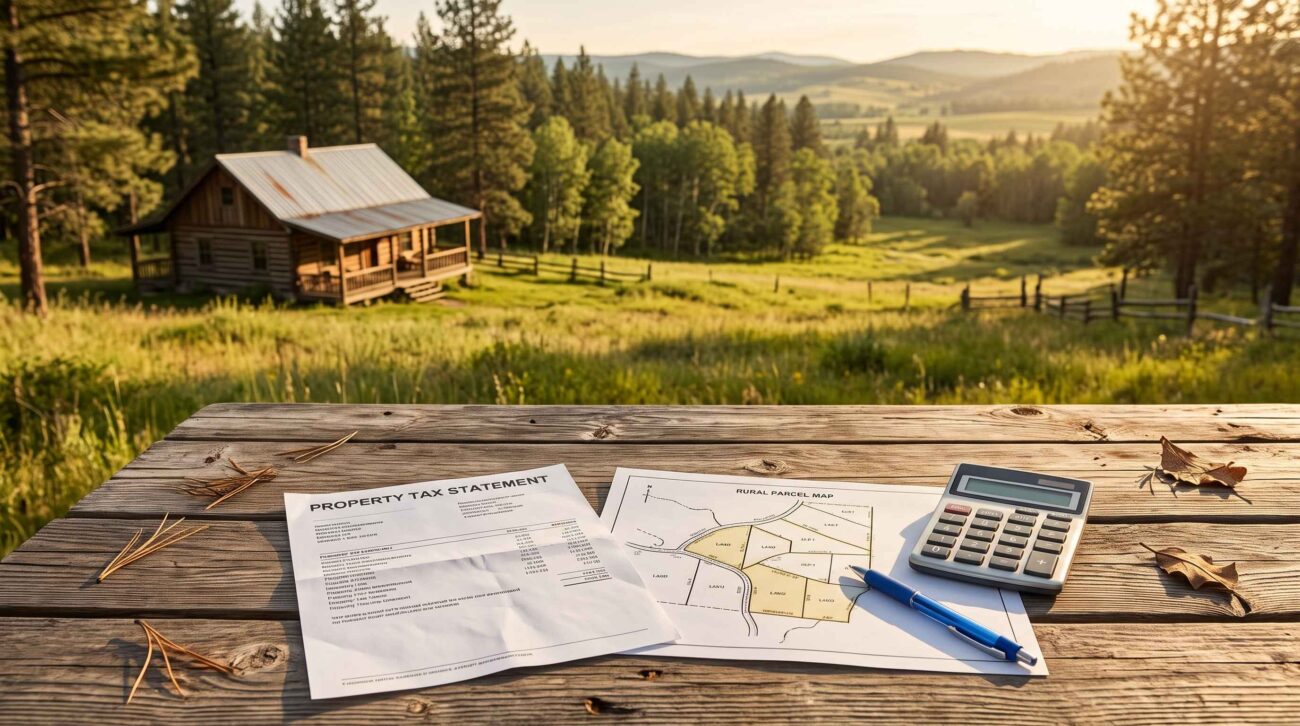
A remote 40-acre property listed for $95,000 may look surprisingly affordable. It has wooded hills, a gravel driveway, and enough open space for a future cabin.
The listing also shows annual property taxes of just $350.
That figure may be accurate for the current owner. But it does not necessarily represent what a new buyer will pay.
The property might currently qualify for agricultural valuation, a special exemption, or another form of tax relief. Its assessment may also change under local rules after a sale, new construction, or a change in land use.
Property taxes are an ongoing ownership expense, and the rules vary significantly across the United States.
Before purchasing rural land, buyers should examine official tax records, understand how the property is assessed, investigate special classifications, and ask whether future changes could affect the tax bill.
This guide explains how to research rural property taxes and identify potential surprises before closing.
1. Understand How Property Taxes Work
Property taxes are generally imposed by state-authorized local taxing authorities, such as counties, municipalities, school districts, and special districts.
The amount owed depends on the applicable valuation system, tax rates, exemptions, and other local rules.
In many jurisdictions, property tax calculations involve a taxable or assessed value and one or more tax rates.
However, assessed value, market value, and taxable value are not always the same.
For example, a jurisdiction may apply assessment ratios, special valuations, exemptions, or statutory limits.
Tennessee’s Comptroller of the Treasury explains that assessment and taxation involve separate functions: assessors value and classify property, while local governing bodies determine tax rates.
Source: Tennessee Comptroller — Assessment vs. Taxation.
Why this matters
A property’s purchase price does not automatically equal its assessed value.
Likewise, a low assessed value does not guarantee a low future tax bill.
Buyer takeaway: Understand the local tax calculation before using the seller’s annual tax amount in your ownership budget.
2. Find the Official County Property Tax Records
The first practical step is identifying the government offices responsible for the property’s assessment and tax collection.
Depending on the location, relevant records may be available from a county assessor, appraisal district, treasurer, tax collector, trustee, or another office.
Step-by-step research
Step 1: Identify the correct county and state.
Use the property’s physical location rather than relying only on a mailing address.
Step 2: Find the official assessment website.
Look for a government-operated parcel search or property assessment database.
Step 3: Search the property.
Depending on the system, you may be able to search using:
- Street address
- Parcel identification number
- Owner name
- Legal description
Step 4: Review the assessment information.
Look for the land value, improvement value, assessment classification, exemptions, and relevant assessment dates.
Step 5: Locate the tax collector’s records.
The assessment database and payment records may be maintained separately.
Step 6: Save the documents.
Keep copies of the latest tax bill, assessment record, and payment history.
Important limitation
Online databases may contain outdated information or omit details needed for a purchase decision.
When something is unclear, contact the responsible office directly.
3. Read the Property Tax Bill Carefully
A property tax bill can contain more information than a single annual total.
Depending on the jurisdiction, it may identify multiple taxing authorities, tax rates, exemptions, special assessments, and payment deadlines.
| Tax bill item | What buyers should investigate |
|---|---|
| Parcel identification | Does it match the property being purchased? |
| Tax year | Is the bill current or historical? |
| Assessed or taxable value | What valuation system applies? |
| Property classification | Is the parcel residential, agricultural, timberland, or another category? |
| Exemptions | Does the current owner receive special tax relief? |
| Taxing districts | Which local authorities impose taxes? |
| Special assessments | Are there additional charges beyond ordinary property taxes? |
| Amount due | Is the bill fully paid? |
| Delinquency status | Are any earlier taxes outstanding? |
Do not assume the total shown on a real estate listing includes every applicable charge.
For example, a separate assessment or fee may require additional research.
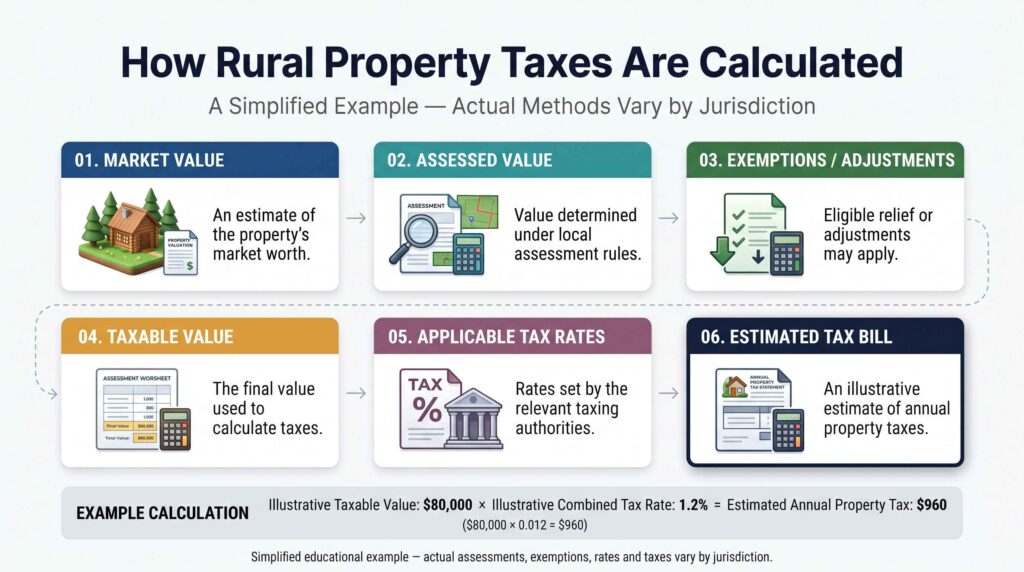
4. Understand Assessed Value vs. Market Value
Market value generally refers to an estimate of what property could sell for under relevant market conditions.
Assessed value is determined under the jurisdiction’s property tax assessment rules.
Taxable value may reflect further adjustments, limitations, or exemptions.
Fictional example
Consider a rural parcel with:
- Advertised purchase price: $120,000
- Assessor’s appraised value: $90,000
- Taxable value: $45,000
These three figures can differ.
The specific explanation depends on the local assessment system.
Do not assume the property’s taxable value will remain $45,000 after the purchase.
The Tennessee Comptroller’s property assessment glossary explains common terms such as assessment, tax base, and tax rate.
Source: Tennessee Property Assessment Glossary.
Questions for the assessor
- How is this property valued?
- What classification currently applies?
- Are there assessment caps or limitations?
- When is the next reassessment?
- Could a sale affect the taxable value?
- How would construction affect the assessment?
5. Check Whether Property Taxes May Change After Purchase
One of the biggest mistakes rural buyers can make is treating the seller’s tax bill as a permanent expense.
Depending on the jurisdiction, changes may occur because of:
- Reassessment cycles
- Ownership transfers
- Expiration or loss of exemptions
- New construction
- Changes in property use
- Changes in local tax rates
- Special assessments
Not every sale automatically causes reassessment, and reassessment procedures vary by state.
Some jurisdictions limit annual increases in certain taxable values. Others use different assessment schedules or valuation methods.
What to ask before closing
Contact the assessor and explain that you are considering purchasing the property.
Ask whether the current assessment or exemption could change after transfer and what information is available for estimating future taxes.
The assessor may not be able to guarantee a future bill.
That limitation is important: a projection is not the same as an official future assessment.
6. Investigate Agricultural and Timberland Tax Classifications
Some rural properties receive special tax treatment because they qualify for agricultural, timberland, or similar use-based valuation programs.
These programs can substantially affect the taxable value of qualifying land.
However, eligibility rules differ by state.
A property advertised as a farm or containing trees does not automatically qualify.
Important questions
- Is the property currently receiving special agricultural or timber valuation?
- What program applies?
- What activities are required to maintain eligibility?
- Are there acreage, productivity, or historical-use requirements?
- Must a new owner apply or notify the assessor?
- Could building a home affect the classification?
- What happens if the land is no longer used for its qualifying purpose?
Texas, for example, has special appraisal provisions for qualifying agricultural, timberland, and wildlife-management uses.
Official resource: Texas Comptroller — Agricultural and Timberland Appraisal.
Buyer takeaway: A low current tax bill may reflect a special valuation that does not match your intended use of the property.
7. Understand Rollback Taxes and Change-of-Use Risks
Certain special valuation programs can create additional tax obligations when qualifying land changes use.
These are sometimes called rollback taxes, change-of-use taxes, or recapture taxes.
The rules, time periods, triggers, and responsible parties vary by jurisdiction.
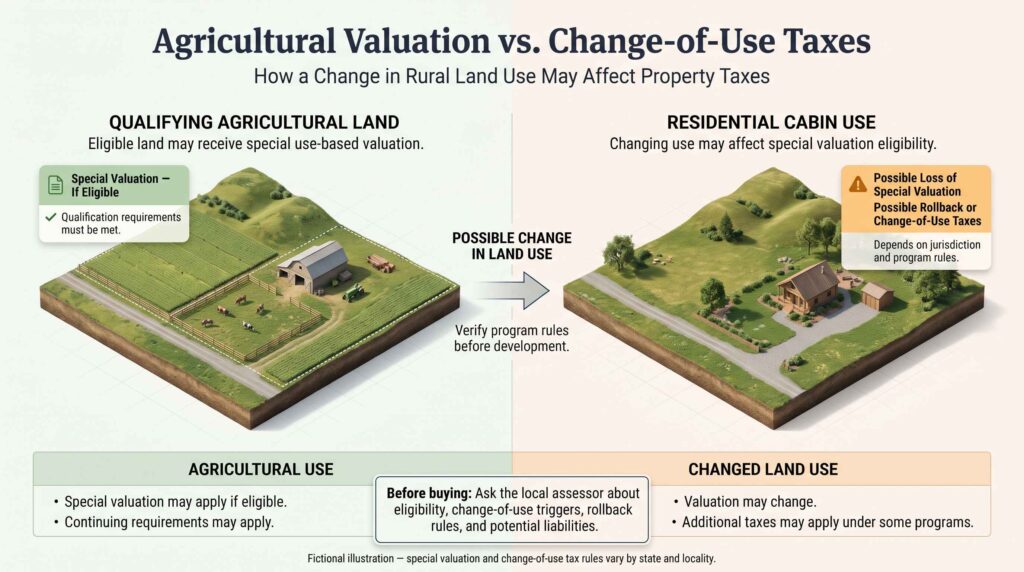
For example, South Carolina’s Department of Revenue explains that agricultural property converted to another use may be subject to rollback taxes calculated from differences in tax treatment.
Source: South Carolina Department of Revenue — Property Tax Exemptions and Rollback Taxes.
Fictional scenario
A buyer purchases 30 acres receiving agricultural valuation.
After closing, the buyer stops the qualifying agricultural activity and develops part of the land for residential use.
Depending on the state, program, and specific facts, that change could affect future valuation or trigger additional taxes.
This is not a prediction that rollback taxes will apply. It illustrates why buyers need to investigate the rules.
Before purchasing specially valued land
Ask the assessor:
- What special valuation applies?
- What activities are required to retain it?
- What events trigger a change-of-use tax?
- How is any additional tax calculated?
- Who may be legally responsible?
- Could the buyer’s planned use trigger the tax?
- Can the office provide written guidance or relevant official materials?
Buyers should also ask their closing attorney or title professional how any potential liability is addressed in the purchase contract.
8. Check Homestead and Other Owner-Specific Exemptions
Some property tax exemptions depend on the owner’s circumstances or how the property is occupied.
Examples may include qualifying primary residences, seniors, veterans, people with disabilities, or other categories established by law.
These programs differ by jurisdiction.
A seller may qualify for relief that the buyer cannot claim.
South Carolina’s Department of Revenue notes that certain exemptions can be affected by changes in ownership or property status.
Source: South Carolina Department of Revenue — Exempt Property.
Questions to investigate
- Does the current owner receive an exemption?
- Is the exemption transferable?
- Must a new owner submit an application?
- Does the property need to be a primary residence?
- Are there deadlines?
- When would an exemption change affect the bill?
A vacant rural parcel and an owner-occupied rural home may be treated differently.
Do not assume a homestead-related benefit applies to vacant land or a recreational cabin.
9. Check for Delinquent Property Taxes
Before buying rural land, verify whether any property taxes remain unpaid.
Delinquent taxes can create significant complications, including interest, penalties, liens, or collection proceedings under applicable law.
The process differs by state.
A seller’s statement that taxes are current should be supported by official records and the closing process.
Recommended checks
- Obtain the latest tax bill.
- Request the current payment status.
- Investigate unpaid prior-year taxes.
- Ask about penalties and interest.
- Review tax liens or pending tax-sale proceedings.
- Confirm how outstanding amounts will be resolved at closing.
A title company or closing attorney can help investigate relevant liens and arrange for appropriate settlement procedures.
Important distinction
The assessor’s website may show valuation information without providing a complete account of unpaid taxes.
Use the relevant collection office or official payment records when verifying delinquency.
10. Understand Tax Prorations at Closing
Property taxes may be paid in arrears, in advance, or according to other schedules depending on the jurisdiction.
During a property sale, the buyer and seller may allocate taxes through a process known as proration.
The settlement statement may contain credits or adjustments reflecting the parties’ agreed responsibilities.
Fictional illustration
Suppose an annual tax amount is $1,200.
The transaction closes halfway through a hypothetical tax period.
If the parties agree to divide that period equally, a simplified illustration would allocate $600 to each side.
However, actual closing calculations depend on the local billing schedule, the contract, available tax figures, and settlement practices.
This example is not a universal closing rule.
Ask the closing professional whether the proration uses actual bills or estimates, and whether later adjustments are possible.
11. Check Special Assessments and Additional Charges
The ordinary property tax bill may not represent every ongoing charge affecting rural land.
Depending on the location, there may be additional assessments or fees associated with services or improvements.
Possible examples include:
- Road improvement districts
- Drainage districts
- Water or sewer districts
- Fire protection services
- Other special taxing districts
Some charges may appear on the tax bill. Others may be billed separately.
What to investigate
Ask the assessor, tax collector, and closing professional whether the parcel is subject to special assessments or outstanding charges.
Also check for private road maintenance obligations.
A private road maintenance agreement is not necessarily a property tax, but it can still affect the total cost of ownership.
Read our related guide: Hidden Costs of Buying Cheap Land in America.
12. Consider How New Construction Could Affect Taxes
Buying vacant land and later building a cabin can change the property’s assessment.
The treatment depends on the jurisdiction, type of improvement, assessment schedule, and applicable exemptions.
A new dwelling, garage, or other taxable improvement may increase assessed value.
Before building
Ask the assessor:
- How are new improvements assessed?
- When are completed structures added to the tax roll?
- Are partially completed buildings assessed?
- Does a new home affect the land’s existing classification?
- Could agricultural valuation change?
- Are there additional reporting requirements?
Do not use the current vacant-land tax bill as the only estimate for a future developed property.
You should also research zoning, building permissions, septic feasibility, and utilities.
See Can You Build a House on Cheap Rural Land?.
13. Estimate Annual Property Taxes Without Guessing
A simple calculation can help buyers understand how taxes may be determined.
In a jurisdiction that taxes property by applying a rate to a taxable value, a simplified formula is:
Estimated property tax = Taxable value × Applicable tax rate
Fictional calculation
Assume:
- Taxable value: $80,000
- Combined tax rate: 1.2%
Estimated annual tax:
$80,000 × 0.012 = $960
This is a mathematical illustration, not an estimate for any particular property or state.
Real tax systems may involve assessment ratios, exemptions, multiple rates, special assessments, and other adjustments.
Better estimation process
- Obtain the current official tax bill.
- Identify the applicable assessment method.
- Review existing exemptions and special classifications.
- Ask what may change after the purchase.
- Ask how planned improvements could affect valuation.
- Use official calculators or guidance where available.
- Budget for uncertainty rather than assuming the lowest historical amount.
Important: There is no single nationwide property tax percentage that accurately predicts the bill for every rural parcel.
14. Compare Two Hypothetical Rural Properties
Consider two fictional 40-acre properties offered at the same purchase price of $100,000.
Property A: Agricultural valuation
The current annual property tax bill is $300.
However, the land receives special agricultural valuation.
The buyer plans to build a cabin and discontinue the existing agricultural use.
The buyer must investigate whether the special valuation can continue and whether any change-of-use tax could apply.
Property B: Standard assessment
The current annual property tax bill is $900.
The parcel does not appear to receive agricultural valuation or an owner-specific exemption.
The buyer still needs to verify the assessment and possible future changes, but there is no identified special agricultural classification requiring investigation.
| Factor | Property A | Property B |
|---|---|---|
| Acreage | 40 acres | 40 acres |
| Purchase price | $100,000 | $100,000 |
| Current annual tax | $300 | $900 |
| Special classification | Agricultural valuation | None identified |
| Intended use | Cabin and recreation | Cabin and recreation |
| Main concern | Loss of valuation and possible rollback taxes | Future reassessment and construction |
| Next step | Ask assessor about eligibility and change of use | Verify future assessment treatment |
Property A has the lower current bill.
But that does not establish that it will remain the lower-tax property after the buyer changes its use.
Property B’s higher historical bill also does not guarantee its taxes will remain unchanged.
The lesson: Compare the tax treatment behind the numbers, not just the annual amount shown in the listing.
Both properties and all figures in this example are fictional.
15. Rural Property Tax Due Diligence Checklist
Use this checklist before closing on rural land.
- Identify the correct county and taxing jurisdiction.
- Confirm the parcel identification number.
- Obtain the current assessment record.
- Obtain the latest official property tax bill.
- Review several years of tax history where available.
- Confirm assessed and taxable values.
- Identify the property’s current tax classification.
- Check agricultural, timberland, or other special valuation.
- Investigate eligibility requirements for special valuation.
- Ask about rollback or change-of-use taxes.
- Review current exemptions.
- Determine whether exemptions may end after transfer.
- Ask whether a sale may affect the assessment.
- Investigate the effect of planned construction.
- Check delinquent taxes and liens.
- Review special assessments and additional charges.
- Ask how taxes will be prorated at closing.
- Confirm the next tax payment deadline.
- Obtain written clarification for important uncertainties.
- Discuss unresolved issues with the assessor and closing professionals.
Frequently Asked Questions
How do I check property taxes before buying rural land?
Start with the official county assessor or appraisal district and the relevant tax collection office. Review the parcel’s assessment, tax bills, payment history, exemptions, and classifications.
Are rural land property taxes always lower than city property taxes?
No. Tax amounts depend on the property’s taxable value, local tax rates, classifications, exemptions, and other rules.
Will I pay the same property taxes as the seller?
Not necessarily. Ownership changes, reassessment, exemptions, and changes in land use may affect the future bill.
Does vacant land have property taxes?
Many vacant parcels are subject to property taxes, although classifications and exemptions vary by jurisdiction.
Can agricultural land receive lower property taxes?
Qualifying land may receive special agricultural or use-based valuation in some states. Eligibility requirements vary.
What are rollback taxes?
Rollback taxes are additional taxes that may arise under certain special valuation programs when qualifying land changes use. The rules differ by state.
Can building a cabin increase property taxes?
Yes, construction may affect assessed value and sometimes property classification. Ask the local assessor how improvements are treated.
Can unpaid property taxes affect a purchase?
Yes. Delinquent taxes may create liens or other legal issues. Buyers should verify payment status and address outstanding amounts before closing.
Is the tax amount on a real estate listing reliable?
It may reflect a historical tax bill, but it should be verified against official records and evaluated for potential changes after purchase.
Can I estimate next year’s tax bill exactly?
Usually not with certainty. Tax rates, valuations, exemptions, and other factors may change. Local officials may provide guidance, but future bills may differ.
Final Thoughts
Property taxes are a continuing expense that deserves careful attention when buying rural land.
The current annual bill is useful information, but it tells only part of the story.
Buyers should investigate assessed value, tax classification, exemptions, delinquent balances, special assessments, and the possible effects of future construction or changes in land use.
The most important step is to verify information through the appropriate local government offices rather than relying entirely on listing data.
A low property tax bill is attractive only when the buyer understands why it is low and whether that treatment is likely to continue.
Official Resources
- Tennessee Comptroller — Assessment vs. Taxation
- Tennessee Comptroller — Property Assessment Glossary
- Texas Comptroller — Agricultural and Timberland Appraisal
- South Carolina Department of Revenue — Property Tax Exemptions
- South Carolina Department of Revenue — Exempt Property
Editorial Disclaimer: This article is for general educational purposes only and does not constitute tax, legal, financial, or real estate advice. Property tax laws, valuation methods, exemptions, and collection procedures vary by state and local jurisdiction. Examples are hypothetical. Buyers should verify property-specific information with the appropriate assessor, tax collector, title professional, or qualified local adviser before making a purchase decision.
