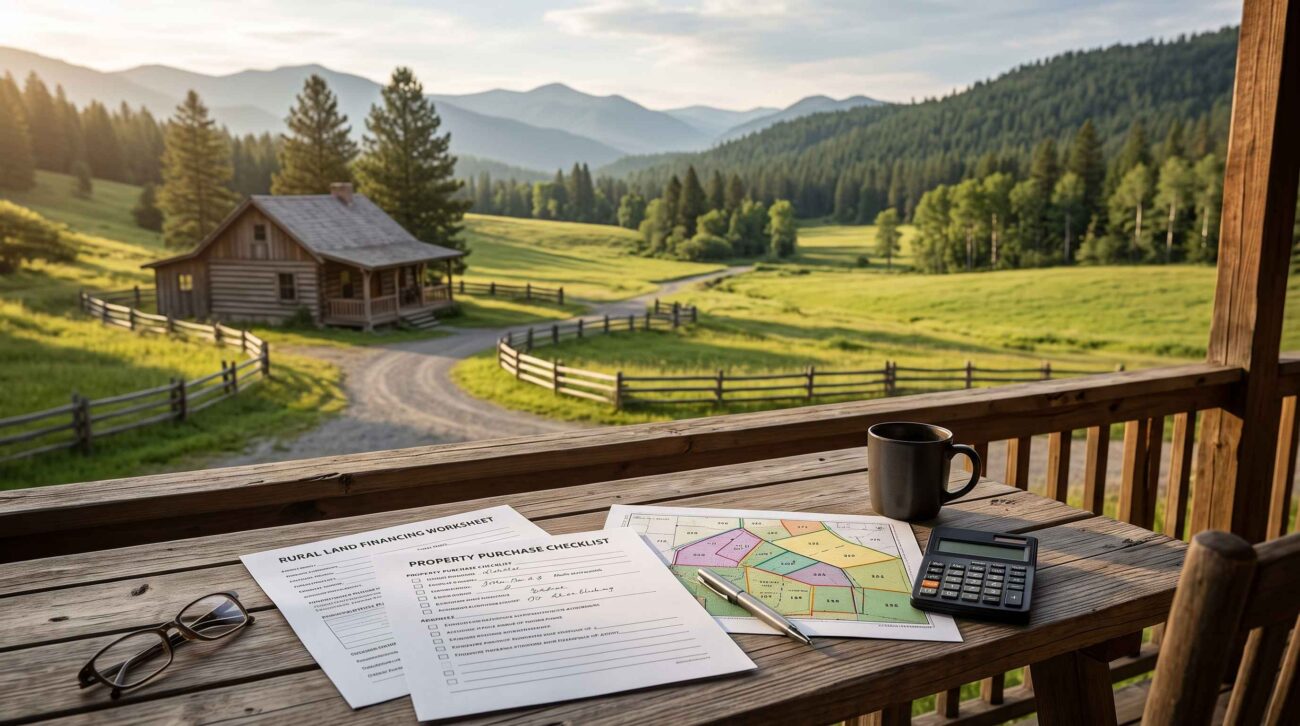
Buying rural land in the United States can open the door to building a cabin, starting a homestead, enjoying recreational acreage, or owning a quiet countryside retreat.
But finding an affordable property is only part of the process.
Financing a vacant wooded parcel is not necessarily the same as obtaining a mortgage for a conventional home. Lenders may evaluate road access, utilities, property condition, intended use, appraisal results, and the borrower’s financial situation differently.
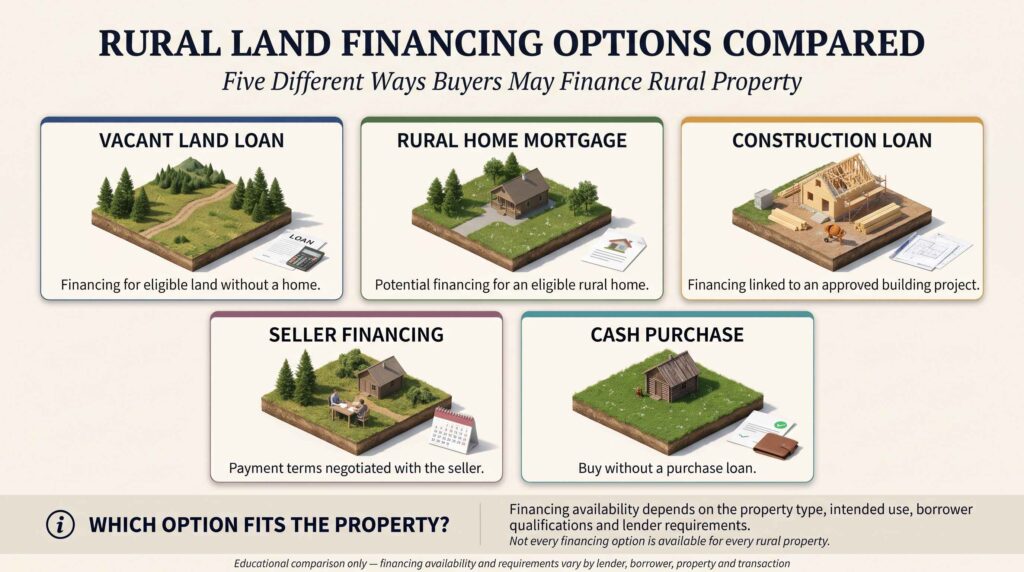
Some rural properties may qualify for conventional residential financing. Others may require a specialized land loan, construction financing, seller financing, or a cash purchase.
The most important step is to identify a realistic financing option before committing to the property.
This guide explains common rural land financing options, what affects down payments, how to compare loan offers, and which property-related risks buyers should investigate before closing.
1. Why Financing Rural Land Can Be Different
A traditional home mortgage generally involves a residential property that meets the lender’s applicable requirements.
Vacant land may have no house, no established utilities, and limited improvements. Its value and potential resale market can also be harder to evaluate.
A lender considering a rural land loan may investigate:
- Whether the property has legal and practical road access.
- The condition of roads and available utilities.
- Whether the land is vacant, improved, or contains an existing dwelling.
- The intended use of the property.
- Zoning and applicable land-use restrictions.
- The property’s appraised value and marketability.
- The borrower’s income, credit, debts, and available funds.
- The loan amount and proposed repayment terms.
Different lenders have different underwriting policies.
A lender willing to finance a rural cabin may not offer financing for unimproved acreage with no dwelling.
Buyer takeaway: Ask lenders about the exact property type before assuming a standard mortgage is available.
2. Common Ways to Finance Rural Land
There are several potential financing approaches. Their availability depends on the property, lender, borrower, and transaction.
Vacant Land Loans
A vacant land loan may be used to purchase property without an existing residence.
Some lenders distinguish between unimproved land and land with existing improvements such as road access or utilities.
Loan terms, down payments, and eligibility requirements vary.
Rural Home Mortgages
A property with an eligible existing home or cabin may qualify for residential mortgage financing.
However, a cabin’s presence does not automatically make the property mortgage-eligible.
The lender may consider the home’s condition, utilities, occupancy suitability, appraisal, and other property requirements.
Construction Loans
Buyers intending to build may investigate construction financing.
Some programs combine construction and permanent financing, while others involve separate financing stages.
The lender may require approved plans, budgets, permits, qualified builders, and construction schedules.
Seller Financing
In some transactions, the seller agrees to receive payments from the buyer rather than requiring the entire purchase price at closing.
This arrangement requires careful legal and financial review.
Cash Purchase
Buying with cash avoids the need for a purchase loan but does not eliminate due diligence, title, survey, environmental, or development risks.
A cash buyer should still investigate the property before closing.
3. Raw Land vs. Improved Land: Why the Difference Matters
Land financing often depends on the property’s physical condition and available infrastructure.
Raw or Unimproved Land
A raw parcel may lack a developed driveway, utility connections, water supply, or wastewater system.
Such properties may require substantial additional investment before construction.
Improved Land
An improved parcel may already have some infrastructure, such as an established road, electricity, water connection, or permitted improvements.
However, the term improved does not guarantee that every utility is operational, legal, or sufficient for the buyer’s plans.
Property With an Existing Home
A rural property containing a dwelling may qualify for different financing products than vacant land.
The lender still needs to determine whether the dwelling meets the relevant loan requirements.
| Property type | Possible financing considerations |
|---|---|
| Remote vacant acreage | Land-loan availability, access, appraisal, intended use |
| Land with utilities | Verification of connections and lender eligibility |
| Rural cabin | Habitability, condition, utilities, appraisal |
| Land for new construction | Construction plans, permits, budget, builder requirements |
| Rural primary residence | Residential mortgage and possible program eligibility |
These are general categories, not universal lender classifications.
4. How Much Down Payment Is Needed for Rural Land?
There is no universal down payment requirement for every rural land purchase.
The amount may depend on the loan program, lender, property type, credit profile, loan-to-value ratio, and other underwriting factors.
A lender financing unimproved acreage may require different borrower funds than a lender financing an eligible primary residence.
Buyers should avoid relying on a single advertised percentage.
Questions to ask
- What is the minimum required down payment for this property?
- Is the requirement based on the purchase price or appraised value?
- What happens if the appraisal is lower than the agreed purchase price?
- Are closing costs payable separately?
- Are cash reserves required?
- Can any eligible funds come from documented gifts?
- Does the proposed loan have a balloon payment?
Request written loan terms rather than relying on a verbal estimate.
Fictional down payment example
Imagine a rural property with an asking price of $100,000.
If a hypothetical lender requires 25% down based on that price, the illustrative down payment would be $25,000, before other costs.
If a different hypothetical lender requires 35%, the illustrative amount would be $35,000.
These percentages are fictional examples, not market averages, lender quotes, or recommendations.
Actual requirements must be confirmed with the lender.
5. Interest Rates, Loan Terms, and Monthly Payments
The down payment is only one part of financing.
Buyers should also compare:
- Interest rate.
- Annual percentage rate (APR), where applicable and disclosed.
- Fixed or variable rate structure.
- Repayment term.
- Monthly principal and interest.
- Origination and other lender fees.
- Prepayment conditions.
- Balloon payment provisions.
- Whether refinancing may eventually be necessary.
A lower monthly payment does not always mean a lower total borrowing cost.
For example, extending repayment over a longer period can reduce the monthly principal-and-interest payment while increasing total interest, depending on the terms.
Some land loans may have shorter repayment periods or different structures than standard residential mortgages.
Ask the lender for a written payment schedule and a clear explanation of the total financial obligation.
6. Can You Use a USDA Loan to Buy Rural Land?
USDA Rural Development offers housing programs that can help eligible applicants purchase or build homes in qualifying rural areas.
However, buyers must distinguish housing finance from financing a standalone vacant land purchase.
The USDA Single Family Housing Guaranteed Loan Program is intended for eligible primary residences and qualifying borrowers.
According to USDA, eligible uses can include a site with a new or existing dwelling, subject to program requirements. Certain construction-to-permanent financing options may also be available through participating lenders.
That does not mean an ordinary USDA housing loan automatically finances vacant acreage held solely for recreation, investment, or future unspecified development.
USDA also administers a Single Family Housing Direct Loan Program for qualifying applicants.
Important eligibility considerations
- The property must meet applicable program requirements.
- The borrower must meet income and other eligibility criteria.
- The dwelling must be used as an eligible primary residence.
- Property condition and appraisal requirements apply.
- Participating lender or agency review is necessary.
- Geographic eligibility alone does not guarantee loan approval.
A property appearing within a USDA-eligible rural area does not establish that the borrower or property qualifies for financing.
Official sources:
USDA — Single Family Housing Guaranteed Loan Program
USDA — Single Family Housing Direct Home Loans
USDA — Property and Income Eligibility
7. How to Compare Rural Land Loan Offers
Two lenders may offer substantially different terms for the same rural property.
Before choosing a financing option, compare written proposals.
| Loan feature | What buyers should verify |
|---|---|
| Loan type | Land, residential mortgage, construction, or another product |
| Down payment | Required funds and how the amount is calculated |
| Interest rate | Fixed or variable and applicable adjustment terms |
| APR | Available disclosures and included borrowing costs |
| Loan term | Repayment period and maturity date |
| Balloon payment | Whether a large final payment is required |
| Fees | Origination, appraisal, title, and other charges |
| Property conditions | Access, utilities, dwelling, and appraisal requirements |
| Closing timeline | Whether the lender can meet contract deadlines |
| Prepayment | Applicable restrictions or charges |
Ask for clarification
A written offer should explain the loan product and its important conditions.
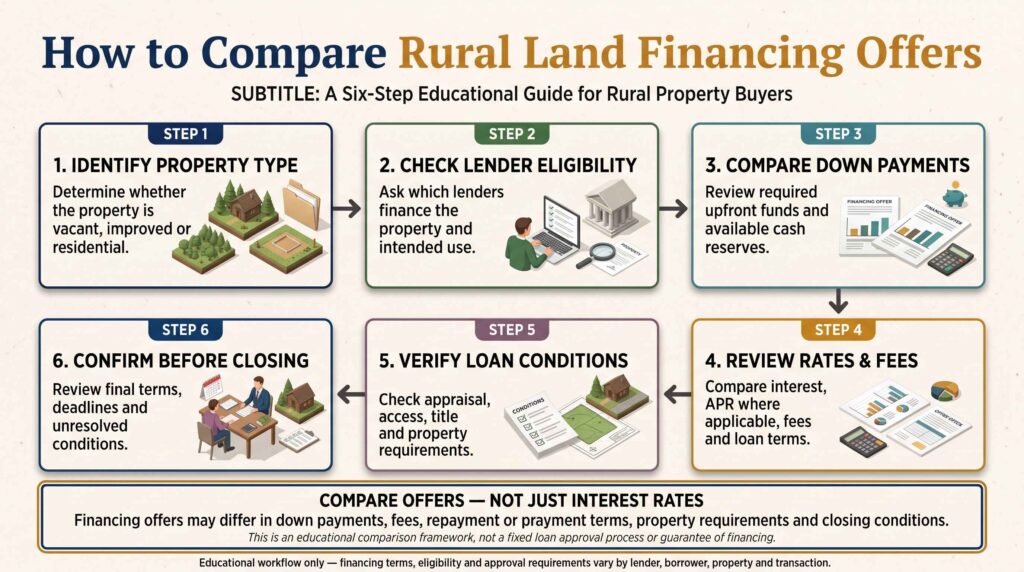
Do not compare offers using the interest rate alone.
A lower rate with substantial fees or a short repayment term may not be the most suitable option.
Also ask whether the loan approval depends on an appraisal, survey, title review, or additional property inspections.
8. How Road Access Can Affect Financing
A rural property may have a visible driveway without a clearly documented legal right to use it.
This can become important when the driveway crosses neighboring land or relies on an easement.
Some lenders or title insurers may require satisfactory access documentation.
Buyers should investigate:
- Whether access is public or private.
- Whether recorded easements exist.
- Whether the driveway crosses another parcel.
- Who maintains the road.
- Whether access is practical throughout the year.
- Whether road conditions affect the lender’s requirements.
Do not assume that a road visible on a satellite map establishes legal access.
Read our guide: Legal Road Access When Buying Rural Land.
9. Utilities and Property Condition: Common Financing Questions
Lenders may consider the condition and suitability of an existing home or cabin.
A remote cabin with a generator, private well, or septic system may require additional review depending on the loan program.
Buyers should verify whether utilities are:
- Available at the road.
- Connected to the property.
- Operational.
- Permitted where required.
- Sufficient for the intended use.
A listing that says electric nearby does not necessarily mean an affordable or approved connection is available.
Similarly, a property described as having a well or septic system does not establish that the systems are functional or meet applicable requirements.
Related resources:
Rural Property Utilities Checklist
Septic Requirements Before Buying Rural Land
Well Water Testing Before Buying Rural Property
10. Can You Finance Land for a Future Cabin?
Potentially, but the financing strategy should match the actual construction plan.
A buyer purchasing land now and building several years later may face different options than someone ready to begin an approved construction project immediately.
Before buying, investigate:
- Whether residential construction is permitted.
- Minimum lot sizes and setback rules.
- Legal access and driveway permits.
- Septic feasibility.
- Water supply options.
- Electric service or approved alternatives.
- Site preparation costs.
- Survey requirements.
- Construction financing availability.
- Permitting and construction schedules.
A lender may require additional documentation before approving construction-related financing.
Buying land does not guarantee that a future cabin will be permitted or financeable.
For more information, read Can You Build a House on Cheap Rural Land?.
11. Seller Financing: Benefits and Risks
Seller financing can provide an alternative when a buyer cannot obtain conventional land financing or prefers a negotiated arrangement.
In a typical arrangement, the buyer agrees to make payments under documents negotiated with the seller.
But seller-financed transactions can involve important risks.
Issues to investigate
Ownership and title: Confirm the seller has the legal authority to sell and determine whether existing liens or mortgages affect the transaction.
Interest and payment structure: Understand the rate, payment schedule, and total amount due.
Balloon payments: Some agreements require a large final payment that the buyer may need to refinance or pay in cash.
Default provisions: Understand what happens if a payment is missed.
Deed transfer: Clarify when and how ownership transfers.
Taxes and insurance: Establish who is responsible for each expense.
Recording and legal protections: Ask a qualified attorney how the transaction should be documented under applicable state law.
Seller financing is not automatically easier, safer, or cheaper than borrowing from a regulated lender.
A qualified real estate attorney should review the proposed agreement before the buyer signs.
12. Owner-Financed Land Listings: Warning Signs
Online listings sometimes advertise low monthly payments or minimal upfront costs.
These advertisements may omit important information about the complete financial obligation.
Potential warning signs include:
- Unclear total purchase price.
- Missing interest-rate information.
- Large undisclosed final payments.
- Unexplained processing or servicing fees.
- Unclear title-transfer provisions.
- No independent title review.
- Pressure to sign immediately.
- Restrictions on inspecting the property.
- Claims that financing approval guarantees buildability.
Buyers should verify the seller’s ownership and request complete written terms.
Never assume that a low advertised monthly payment makes a rural parcel affordable overall.
13. Costs Beyond the Land Loan
The purchase price and down payment may represent only part of the required budget.
Depending on the property, buyers may also face:
- Appraisal fees.
- Survey costs.
- Title examination and insurance.
- Closing and recording fees.
- Property taxes.
- Road or driveway improvements.
- Well installation or testing.
- Septic feasibility and installation.
- Utility extensions.
- Environmental assessments.
- Land clearing and grading.
- Construction permits.
- Insurance and ongoing maintenance.
These costs may be substantial, especially for remote unimproved land.
Some may need to be paid before financing is finalized.
For additional guidance, see Hidden Costs of Buying Cheap Land in America.
Also read Land Survey Cost Before Buying Rural Property.
14. What Happens if the Property Appraises Below the Purchase Price?
A lender may require an appraisal to evaluate the property’s value as collateral.
If the appraised value is below the agreed purchase price, the lender may limit the amount it is willing to finance.
The buyer could then need additional funds, negotiate a lower price, seek another financing arrangement, or reconsider the purchase.
The available options depend on the contract and lender requirements.
A financing or appraisal contingency may provide contractual protections, but only if appropriately included and exercised under the purchase agreement.
Do not assume that loan preapproval guarantees approval of a particular rural property.
15. Fictional Example: Two Rural Properties With Different Financing Challenges
Consider two hypothetical properties offered at the same asking price.
| Feature | Property A | Property B |
|---|---|---|
| Asking price | $120,000 | $120,000 |
| Land | 25 acres | 40 acres |
| Existing dwelling | Modest residential cabin | No dwelling |
| Road access | Documented public road frontage | Private access requires verification |
| Electricity | Connected | No existing connection |
| Water | Existing well, condition unverified | No developed water supply |
| Potential financing | Residential loan review may be possible | Specialized land financing may be needed |
| Main concerns | Dwelling condition and appraisal | Access, infrastructure, lender eligibility |
Both properties may be attractive to different buyers.
Property A is not automatically eligible for a mortgage, and Property B is not automatically ineligible for financing.
The lender must evaluate the actual property and borrower.
Fictional illustration only: These examples are not real listings, financing offers, or eligibility determinations.
16. Rural Land Financing Checklist Before Closing
Use this checklist to organize your financing due diligence.
- Identify whether the property is vacant land or contains an existing dwelling.
- Confirm the intended use of the property.
- Ask lenders whether they finance that property type.
- Obtain written financing estimates.
- Confirm down payment requirements.
- Compare rates, fees, terms, and possible balloon payments.
- Review loan-related property requirements.
- Verify legal road access.
- Investigate utilities and existing systems.
- Review zoning and building restrictions.
- Ask about appraisal and survey requirements.
- Review title and recorded encumbrances.
- Estimate closing and development costs.
- Check financing and inspection contingency deadlines.
- Obtain legal review of seller-financing documents, if applicable.
- Resolve material concerns before closing.
Frequently Asked Questions
Can I get a loan to buy vacant rural land?
Possibly. Some lenders offer specialized land loans, but availability and requirements depend on the borrower, parcel, and lender. A standard home mortgage may not be appropriate for unimproved land.
What is the minimum down payment for a land loan?
There is no universal minimum for all rural land loans. The requirement depends on the lender, financing product, borrower, and property.
Can I buy 40 acres with a USDA loan?
Acreage alone does not determine eligibility. USDA housing programs have borrower, property, occupancy, and other requirements. An eligible site associated with a qualifying dwelling may be considered under applicable program rules, but a standalone vacant-land purchase should not be assumed eligible.
Can I finance an off-grid cabin?
Potentially, but financing depends on the dwelling’s condition, utility arrangements, applicable property standards, lender requirements, and intended occupancy.
Is seller financing safer than a bank loan?
Not necessarily. Seller financing has different legal and financial risks, including potential title issues, balloon payments, and default provisions. Independent legal review is important.
Does loan preapproval guarantee I can buy a particular rural property?
No. Final approval may depend on appraisal, title, access, property condition, underwriting, and other requirements.
Can I finance land and cabin construction together?
Some lenders and qualifying programs offer construction-to-permanent financing. Availability and requirements vary, and the buyer may need approved plans, budgets, permits, and other documentation.
What if a rural property has no legal road access?
That can create significant ownership, usability, title, and financing concerns. Buyers should obtain qualified legal and title advice before committing to the purchase.
Final Thoughts
Financing rural land requires more than finding a lender willing to discuss a loan.
Buyers should understand the property type, intended use, financing structure, down payment, total borrowing cost, and any conditions that could prevent final approval.
A vacant wooded parcel, an off-grid cabin, and a completed rural primary residence may qualify for very different financing products.
Before closing, compare written loan terms, investigate the property thoroughly, and seek appropriate professional advice.
The best financing arrangement is one that fits both the buyer’s financial situation and the actual property’s legal and physical characteristics.
Official and Professional Resources
- USDA Rural Development — Single Family Housing Guaranteed Loan Program
https://www.rd.usda.gov/programs-services/single-family-housing-programs/single-family-housing-guaranteed-loan-program - USDA Rural Development — Single Family Housing Direct Home Loans
https://www.rd.usda.gov/programs-services/single-family-housing-programs/direct-home-loans - USDA Rural Development — Property and Income Eligibility
https://eligibility.sc.egov.usda.gov/eligibility/ - Consumer Financial Protection Bureau — Buying a House
https://www.consumerfinance.gov/owning-a-home/ - Consumer Financial Protection Bureau — Loan Estimate Explainer
https://www.consumerfinance.gov/owning-a-home/loan-estimate/ - State Banking or Financial Regulatory Authority
Consult the appropriate state authority to verify licensing or regulatory information for applicable lenders and financing arrangements. - County Recorder or Register of Deeds
Consult the relevant county office for recorded deeds, liens, and property records.
Editorial Disclaimer
This article is provided for general educational purposes only. It does not constitute financial, mortgage, legal, tax, surveying, or real estate advice.
Financing products, rates, down payment requirements, government program eligibility, lender underwriting standards, and state laws vary and may change.
All hypothetical prices, percentages, property descriptions, and financing examples are fictional and should not be interpreted as actual loan offers or market averages.
Before making a financial commitment, consult qualified lenders, licensed financial professionals, title specialists, and real estate attorneys as appropriate.
