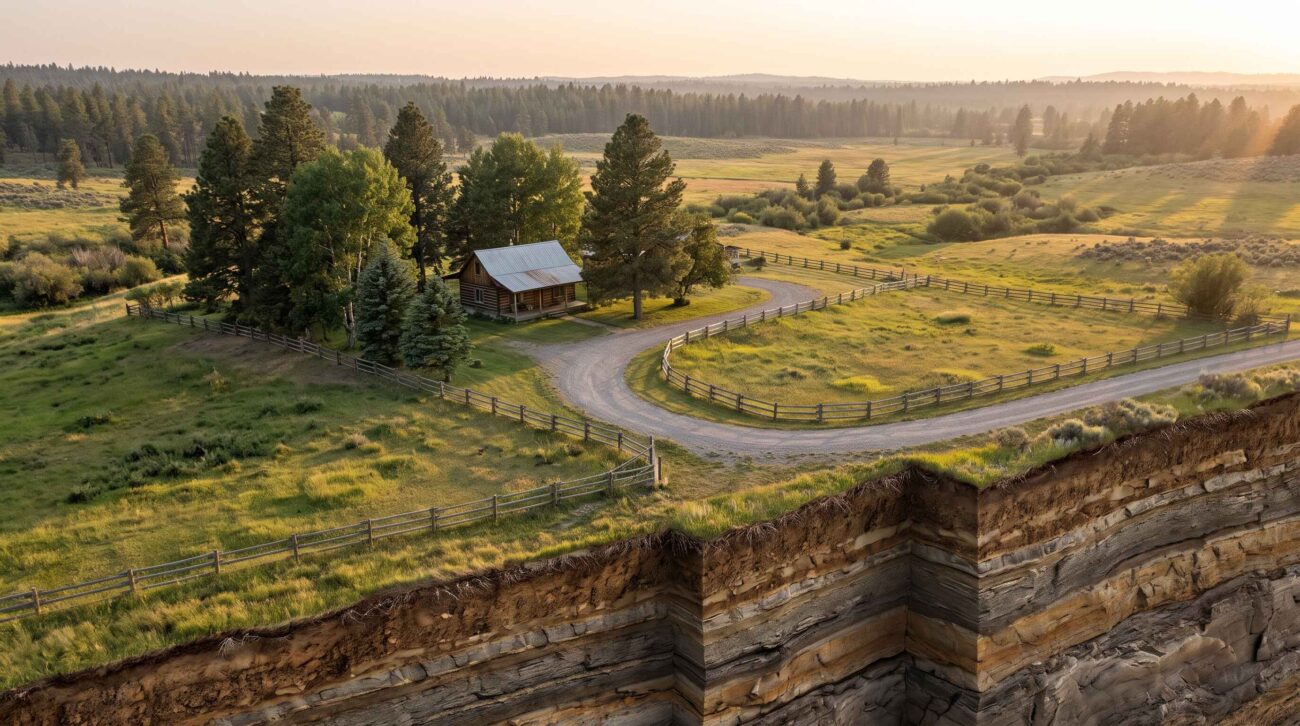
A wooded 40-acre property in the American countryside may seem like an ideal place to build a cabin, establish a homestead, or enjoy a quiet weekend retreat.
The listing might describe mature trees, mountain views, wildlife, and a private driveway. But one important ownership question may receive little attention:
Who owns the minerals beneath the property?
Buying rural land does not always mean purchasing every property right associated with it.
In some parts of the United States, surface ownership and mineral ownership have been separated through earlier deeds, government reservations, inheritance, or other transactions.
This arrangement is commonly called a split estate.
Depending on the rights involved, another party may own or lease certain minerals beneath land owned by someone else. That can create questions about exploration, development, access, and future land use.
This guide explains how to investigate mineral rights before buying rural property, which records to review, and what questions to ask before closing.
1. Understand What Mineral Rights Are
Mineral rights are property interests associated with certain mineral resources beneath the land.
Depending on the jurisdiction and the wording of the relevant documents, these interests may involve resources such as:
- Oil
- Natural gas
- Coal
- Metallic minerals
- Other subsurface mineral resources
The legal meaning of a mineral interest can vary. Not every substance beneath a property is necessarily included in a particular mineral conveyance or reservation.
For example, the ownership and classification of sand, gravel, stone, and other materials may require separate investigation.
The U.S. Bureau of Land Management (BLM) advises landowners to verify ownership before extracting or selling certain mineral materials, particularly where federal mineral ownership may exist.
Official source: BLM — Know Before You Dig.
Why mineral rights matter
A buyer may intend to use rural property only for recreation or residential purposes.
However, mineral ownership can affect what rights other parties hold in relation to the land.
Buyer takeaway: Never assume that ownership of the surface automatically includes ownership of every mineral beneath it.
2. Surface Rights vs. Mineral Rights
Surface rights generally relate to ownership and use of the land’s surface, subject to applicable laws and other property interests.
Mineral rights concern legally recognized interests in mineral resources.
These interests may belong to the same owner or to different parties.
| Ownership interest | General meaning | Buyer question |
|---|---|---|
| Surface rights | Rights associated with the land’s surface | What land uses and improvements are permitted? |
| Mineral rights | Interests in certain mineral resources | Who owns the relevant mineral estate? |
| Mineral lease | Rights granted under a particular lease | Is a lease active, and what does it authorize? |
| Surface-use rights | Rights that may allow certain mineral-related surface activities | Could operations affect the property? |
The precise rights depend on recorded instruments, applicable law, and other relevant agreements.
A mineral owner does not necessarily have unlimited permission to use the surface.
Likewise, a surface owner does not necessarily have authority to prevent all mineral development.
3. What Is a Split Estate?
A split estate exists when surface ownership and mineral ownership are held separately.
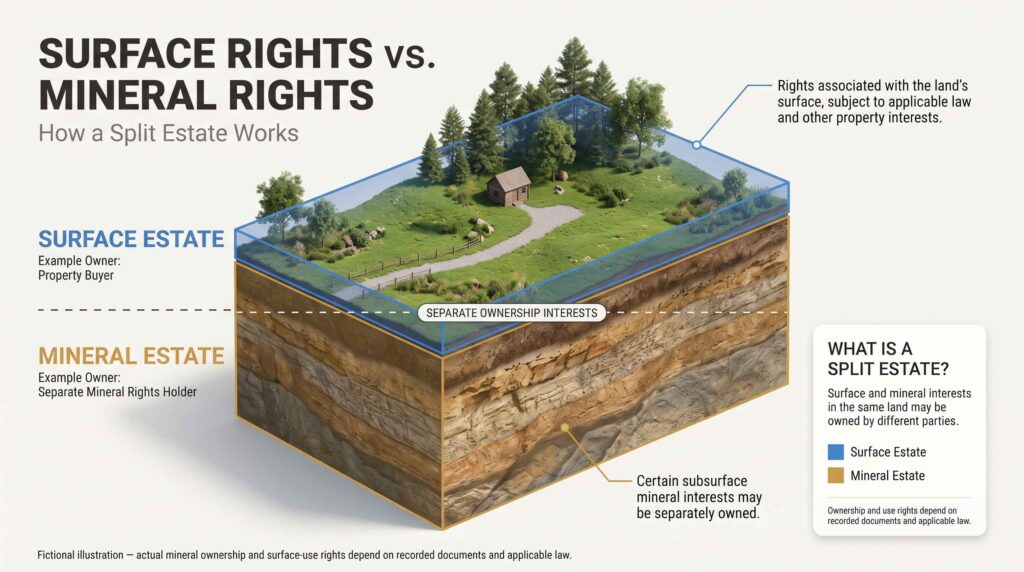
For example, a private individual might own the surface of a rural parcel while another individual, company, or government entity owns some or all of the mineral interests.
The BLM explains that split-estate situations exist in portions of the American West, including land where the federal government retained mineral interests while the surface entered private ownership.
Official source: BLM — Mining and Minerals: Split Estate.
Fictional example
Imagine a 60-acre rural property.
The seller owns the surface and can convey that interest.
However, a previous owner reserved certain mineral rights decades earlier.
The current seller may not be able to transfer those reserved mineral interests because they are no longer part of the seller’s ownership.
The buyer could therefore acquire the land without acquiring the reserved minerals.
Important: The existence of a split estate does not prove that mineral development will occur. It means the buyer needs to understand the separate ownership interests and their possible consequences.
4. Start With the Current Property Deed
The current deed is an important starting point.
A deed may contain language referring to:
- Mineral reservations
- Exceptions from the conveyance
- Previously reserved oil and gas interests
- Existing easements or rights
- Earlier recorded documents
Look for phrases such as:
- “Excepting and reserving…”
- “Oil, gas and other minerals…”
- “Subject to prior reservations…”
- “Mineral interests previously conveyed…”
These examples are only research clues. Their legal effects depend on the complete document and applicable law.
Important limitation
The current deed may not explain the entire mineral ownership history.
A mineral interest could have been separated in an earlier transaction and may not be fully described in the most recent deed.
Therefore, reading only the seller’s deed is not enough to establish mineral ownership.
For a broader explanation of recorded property restrictions, see How to Check Deed Restrictions Before Buying Land.
5. Search County Land Records for Mineral Reservations
County land records are another important source.
Depending on the jurisdiction, documents may be recorded through the county recorder, register of deeds, county clerk, or another recording office.
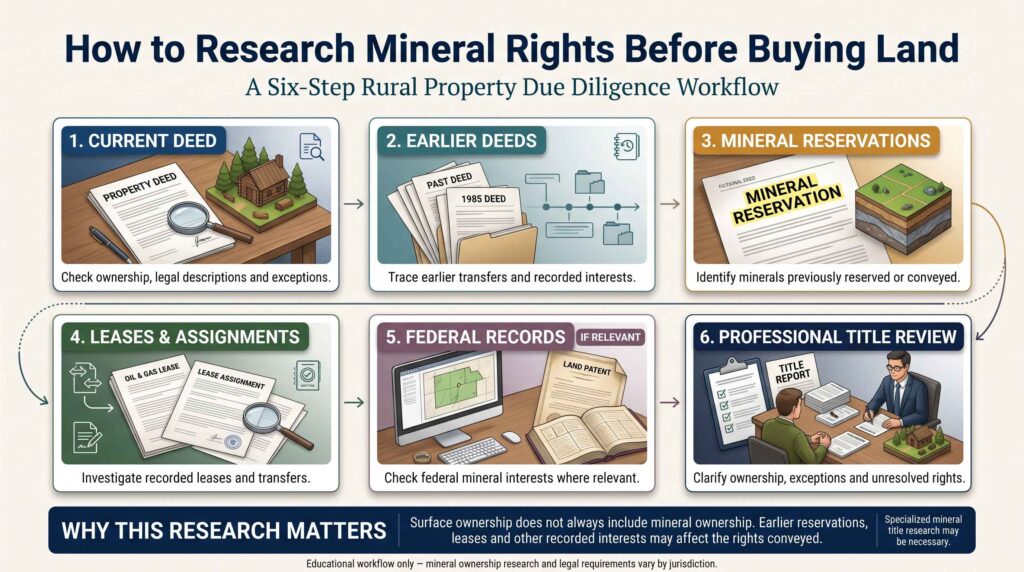
Step-by-step research process
Step 1 — Review the Current Deed
Obtain the property’s current recorded deed from the appropriate county recording office. Confirm the legal description, ownership information, exceptions, and references to earlier documents. Look for language involving oil, gas, minerals, or previously reserved interests.
Step 2 — Examine Earlier Deeds
Trace earlier property transfers through the county land records. Mineral rights may have been reserved or conveyed separately many years before the current deed was recorded. Review earlier documents to identify potential changes in ownership.
Step 3 — Identify Mineral Reservations
Search for recorded mineral deeds, reservations, and exceptions. Determine whether any mineral interests were separated from surface ownership. Pay attention to the specific minerals involved and whether ownership may be divided among multiple parties.
Step 4 — Investigate Leases and Assignments
Look for recorded oil and gas leases, mineral assignments, amendments, releases, and relevant surface-use agreements. These documents may help identify additional interests or activities affecting the property. A recorded lease does not necessarily mean active mineral development is taking place.
Step 5 — Check Federal Records (If Relevant)
If federal mineral ownership may be involved, investigate relevant Bureau of Land Management records, original land patents, and other available federal land documents. Federal mineral reservations can exist beneath privately owned surface land. Not every rural property requires this step.
For more information, see Section 7: Check Whether the Federal Government Owns the Minerals.
Step 6 — Obtain Professional Title Review
Ask a qualified title professional or real estate attorney experienced in mineral ownership to review the relevant documents. A specialized mineral title examination may be necessary to clarify ownership, fractional interests, recorded exceptions, and unresolved legal questions.
Important: This workflow provides general research guidance. Recording systems, mineral ownership laws, and required investigations vary by jurisdiction. Completing these steps does not guarantee that all mineral title issues have been resolved.
Why this can be complicated
A mineral estate may have multiple owners or fractional interests.
Historical records can also be difficult to interpret.
Online county databases may not contain every older instrument.
A complete mineral ownership investigation may require specialized title research beyond an ordinary parcel lookup.
6. Review the Title Commitment and Its Exceptions
A title commitment or preliminary title report may identify recorded matters relevant to the proposed purchase.
Buyers should examine any exceptions involving:
- Mineral reservations
- Oil and gas interests
- Mining rights
- Mineral leases
- Access rights
- Other recorded encumbrances
However, an ordinary title report or title insurance policy may not establish complete mineral ownership.
Certain mineral interests, surface rights, or associated risks may be excluded from coverage.
Questions for the title company
- Does the proposed transaction include mineral rights?
- What mineral reservations or exceptions appear in the title records?
- Does the title search establish mineral ownership, or is a separate mineral title examination necessary?
- Are any mineral-related matters excluded from coverage?
- Are additional searches or endorsements available?
- Should a mineral-rights attorney review the documents?
Buyer takeaway: Do not treat a standard title insurance policy as a guarantee that you own all subsurface minerals.
7. Check Whether the Federal Government Owns the Minerals
Some privately owned rural properties are located above federally owned mineral estates.
The BLM explains that certain federal land patents reserved mineral rights to the United States.
One historical example involves the Stock Raising Homestead Act of 1916.
The BLM recommends reviewing the original land patent and relevant federal land records when investigating possible federal mineral ownership.
Official source: BLM — Split Estate and Federal Mineral Ownership.
How to investigate
- Identify the property’s legal land description.
- Contact the appropriate BLM state or field office.
- Ask whether the land is associated with federal mineral reservations.
- Review relevant federal land records and master title plats where applicable.
- Investigate the original land patent.
- Confirm how any federal mineral ownership affects the parcel.
A BLM record may help identify federal interests, but it should not be assumed to resolve every possible private mineral ownership question.
8. Investigate Existing Oil and Gas Leases
Mineral ownership and mineral leasing are related but different questions.
A mineral owner may grant certain exploration or production rights through a lease.
The existence of a lease does not necessarily mean active drilling is occurring.
Likewise, the absence of visible wells does not establish that no mineral lease or other mineral interest exists.
Documents worth investigating
- Recorded oil and gas leases
- Lease amendments
- Assignments
- Releases
- Relevant surface-use agreements
- Available permits or operational records
Questions to ask
- Is a mineral lease recorded?
- Who are the parties?
- What minerals are covered?
- Is the lease still effective?
- What activities does it authorize?
- Does it address access or surface use?
- Are any wells or other operations proposed or operating nearby?
Lease interpretation can be highly technical. Buyers should not rely on a listing agent’s informal explanation when important rights remain uncertain.
9. Understand Possible Surface-Use Implications
One reason to investigate mineral rights is that mineral development can sometimes involve surface activities.
Depending on the rights and circumstances, possible activities may include:
- Access roads
- Equipment movement
- Well pads
- Exploration work
- Utility infrastructure
- Temporary construction activities
- Other authorized mineral operations
Not every mineral interest permits every activity.
Rights may be limited by deeds, leases, surface agreements, statutes, regulations, and other applicable requirements.
The BLM explains that federal split-estate oil and gas development involves specific regulatory procedures and surface-management considerations.
Official source: BLM — Leasing and Development of Split Estate.
Practical buyer questions
If a mineral owner or operator has rights affecting the parcel, investigate:
- Where access could occur
- Whether existing roads may be used
- Whether surface facilities are permitted
- What notice requirements apply
- Whether compensation or damage provisions apply
- What restrictions protect existing improvements
- Whether any surface-use agreement is recorded or available
Do not assume that a mineral owner can automatically place equipment anywhere on the property.
10. Mineral Rights and Building a Rural Cabin
A buyer planning to build a cabin should understand any mineral-related rights affecting the intended building site.
A mineral reservation does not automatically prohibit residential construction.
However, unresolved surface-access rights or proposed operations could affect planning.
Before choosing a building location
Investigate:
- Recorded mineral reservations
- Existing leases and surface-use agreements
- Any known operational plans
- Existing wells, roads, or infrastructure
- Potential conflicts with access or development
- Relevant building and land-use regulations
A qualified local attorney can help determine whether mineral-related rights create specific concerns for the planned development.
Also review our guide: Can You Build a House on Cheap Rural Land?.
11. Check for Existing Wells and Mineral Activity
Public regulatory records may help buyers investigate known mineral development.
Depending on the state, an oil and gas commission, environmental agency, geological survey, or other regulator may maintain records of:
- Permitted wells
- Producing wells
- Plugged or abandoned wells
- Well locations
- Production information
- Certain enforcement or operational records
The availability and completeness of these records vary.
Important distinction
A map showing no nearby wells does not prove that mineral rights are included in the property sale.
Mineral ownership must be investigated separately from existing development.
Likewise, a nearby well does not automatically mean the subject property is burdened by a specific mineral lease or surface-use right.
12. Understand That Mineral Rights Can Be Divided
Mineral ownership is not always a simple choice between one surface owner and one mineral owner.
Depending on the jurisdiction and documents, mineral interests may be:
- Owned by multiple parties
- Divided into fractional interests
- Associated with particular minerals
- Subject to leases
- Affected by inheritance
- Transferred independently from the surface
This can make ownership investigations complex.
For example, a seller may own the surface and only a portion of the mineral estate.
A statement such as “mineral rights included” should therefore be clarified in the purchase contract and supporting title documents.
Ask exactly which mineral interests the seller owns and intends to convey.
13. Watch for Red Flags in Rural Property Listings
Some listing descriptions deserve additional investigation.
| Listing statement | What buyers should verify |
|---|---|
| “Mineral rights included” | Which interests are actually owned and conveyed? |
| “Surface rights only” | Who owns the minerals and what rights do they hold? |
| “All rights convey” | Are earlier reservations or exceptions still effective? |
| “No active drilling” | Are leases, permits, or development rights present? |
| “Unrestricted land” | Are mineral reservations or other recorded interests involved? |
| “Oil and gas rights negotiable” | What interests are available, and under what terms? |
These phrases do not automatically indicate a defective property.
They simply highlight the need for documentation.
Buyers should request clarification before making assumptions about ownership.
14. Compare Two Hypothetical Rural Properties
Consider two fictional 40-acre properties offered for $110,000 each.
Property A — Mineral ownership appears included
The seller states that the surface and mineral rights are included.
The preliminary records reviewed do not identify a mineral reservation.
However, the buyer still needs professional confirmation of the seller’s ownership and the exact interests being conveyed.
Property B — Previously reserved minerals
The seller owns the surface, but an earlier deed contains a mineral reservation.
The buyer wants to build a cabin and use the property for recreation.
Before purchasing, the buyer needs to determine who owns the reserved interests and whether any lease or surface-use rights could affect the planned use.
| Factor | Property A | Property B |
|---|---|---|
| Acreage | 40 acres | 40 acres |
| Asking price | $110,000 | $110,000 |
| Surface ownership | Seller | Seller |
| Mineral ownership | Seller claims ownership; verification needed | Earlier reservation identified |
| Main concern | Confirm title and interests conveyed | Investigate reserved rights and possible surface use |
| Recommended next step | Professional title review | Specialized mineral title and legal review |
Neither example establishes that one property is automatically a better purchase.
The decision depends on the buyer’s goals, the documented rights, and the results of due diligence.
All properties and figures are fictional.
15. Mineral Rights Due Diligence Checklist
Use this checklist before purchasing rural land.
- Confirm the property’s legal description.
- Obtain the current recorded deed.
- Review mineral exceptions and reservations.
- Investigate earlier deeds.
- Search for separate mineral conveyances.
- Identify known mineral owners where possible.
- Determine whether mineral interests are fractional or divided.
- Review the title commitment and exceptions.
- Ask whether the seller owns the mineral interests being offered.
- Check for recorded oil and gas leases.
- Investigate surface-use agreements.
- Research known wells and permitted operations.
- Check for possible federal mineral ownership.
- Contact the relevant BLM office where appropriate.
- Review planned cabin or homestead use.
- Investigate access, equipment, and surface-damage provisions.
- Confirm the exact rights described in the purchase contract.
- Obtain specialized legal or title advice when necessary.
- Resolve significant uncertainties before closing.
Frequently Asked Questions
Do mineral rights automatically come with rural land?
No. Mineral rights may have been reserved or transferred separately from surface ownership.
What is a split estate?
A split estate exists when the surface and mineral interests are owned separately.
How do I check who owns the minerals beneath a property?
Start with deeds, recorded mineral documents, title records, and relevant government records. A specialized mineral title examination may be necessary.
Can someone else own minerals beneath my land?
Yes. Another private party, company, or government entity may own certain mineral interests.
Can a mineral owner enter my property?
Some mineral interests may carry surface-use rights, but the extent of those rights depends on applicable law and documents. They are not unlimited.
Does a mineral reservation mean drilling will happen?
No. A reservation establishes or preserves a legal interest; it does not establish that development will occur.
Can I build a cabin if someone else owns the mineral rights?
Possibly. Mineral ownership separation does not automatically prohibit construction. Buyers should investigate any rights that could affect their intended building location.
Does title insurance cover mineral rights?
Coverage depends on the policy and its exceptions. A standard policy may not establish mineral ownership or cover certain mineral-related risks.
How do I check for federally owned mineral rights?
Contact the appropriate BLM office and investigate relevant federal land records, master title plats, and original land patents where applicable.
Should I avoid rural property with severed mineral rights?
Not necessarily. The decision depends on the specific rights, potential impacts, intended use, and buyer’s risk tolerance.
Final Thoughts
Mineral rights are an important but sometimes overlooked part of rural land due diligence.
A buyer may own a beautiful forested property without owning every mineral interest beneath it.
That does not automatically make the property unsuitable for a cabin, homestead, or recreational retreat.
It does mean the buyer should investigate ownership, reservations, leases, and potential surface-use rights before committing to the purchase.
The current deed is a useful starting point, but older records and specialized title research may be necessary.
The most important question is not simply whether mineral rights are mentioned in the listing. It is which rights the seller can legally convey and how any outstanding interests could affect the buyer’s intended use.
Editorial Disclaimer: This article provides general educational information and does not constitute legal, financial, investment, or real estate advice. Mineral ownership, reservations, leases, surface-use rights, and title requirements vary by state and by individual property. All property examples are fictional. Buyers should consult qualified local legal and title professionals and relevant government offices before making property-specific decisions.
