
A wooded 40-acre property with mountain views, a private driveway, and enough space for a cabin may look like the perfect rural retreat.
The listing might describe the land as unrestricted, suitable for a homestead, or ideal for recreational use.
But before buying, there is an important question to investigate: Are there recorded restrictions that limit what the next owner can do with the property?
A deed restriction might limit certain building types, prohibit subdividing the land, establish minimum home sizes, or regulate activities such as keeping livestock.
Some restrictions are associated with planned communities and homeowners associations. Others affect rural parcels with no obvious neighborhood development.
A property can also be subject to restrictions created many years before the current owner purchased it.
That is why buyers should not rely solely on listing descriptions, verbal assurances, or the apparent absence of an HOA.
This guide explains how to research deed restrictions, review recorded covenants, understand their relationship to zoning and easements, and identify questions that should be resolved before closing.
1. What Are Deed Restrictions?
Deed restrictions are private legal limitations or obligations affecting how property may be used.
They may appear directly in a deed or in a separate recorded declaration, agreement, or set of covenants, conditions, and restrictions, commonly called CC&Rs.
Examples can include rules about building design, minimum dwelling size, fences, commercial activities, or land subdivision.
Some covenants are intended to bind future owners. In property law, these are often described as covenants that run with the land.
Cornell Law School’s Legal Information Institute explains that a covenant running with the land can continue to benefit or burden property after ownership changes.
Source: Cornell Law — Covenant That Runs With the Land.
However, not every promise in a deed automatically binds every future owner.
Enforceability depends on the document, the applicable state law, and the surrounding circumstances.
Buyer takeaway: A deed restriction may affect a property long after the person who originally agreed to it has sold the land.
2. Understand Deed Restrictions vs Zoning vs Easements
These terms are related, but they describe different types of property limitations.
Deed restrictions generally arise from private legal instruments or agreements.
Zoning involves land-use regulations adopted by government authorities.
Easements generally involve rights allowing another person or entity to use land for a defined purpose.
| Issue | Deed restriction | Zoning | Easement |
|---|---|---|---|
| Typical source | Private recorded covenant or agreement | Local government regulation | Legal grant or other recognized property right |
| Common example | Minimum house size | Residential land-use classification | Neighbor’s right to use a driveway |
| Main concern | Private limits on property use | Government permission and development rules | Rights affecting access or use of land |
| Where to research | Deed, CC&Rs, title documents | Planning or zoning office | Title documents, recorded instruments, survey |
These categories can overlap.
For example, local zoning might allow a manufactured home while an enforceable private covenant prohibits that housing type.
Likewise, a deed restriction does not replace the need to investigate road access or utility easements.
Read our related guides:
How to Check Zoning Before Buying Rural Land
How to Check Easements Before Buying Rural Land
3. Know the Common Deed Restrictions Affecting Rural Land
Different rural properties may be subject to very different restrictions.
Here are examples worth investigating.
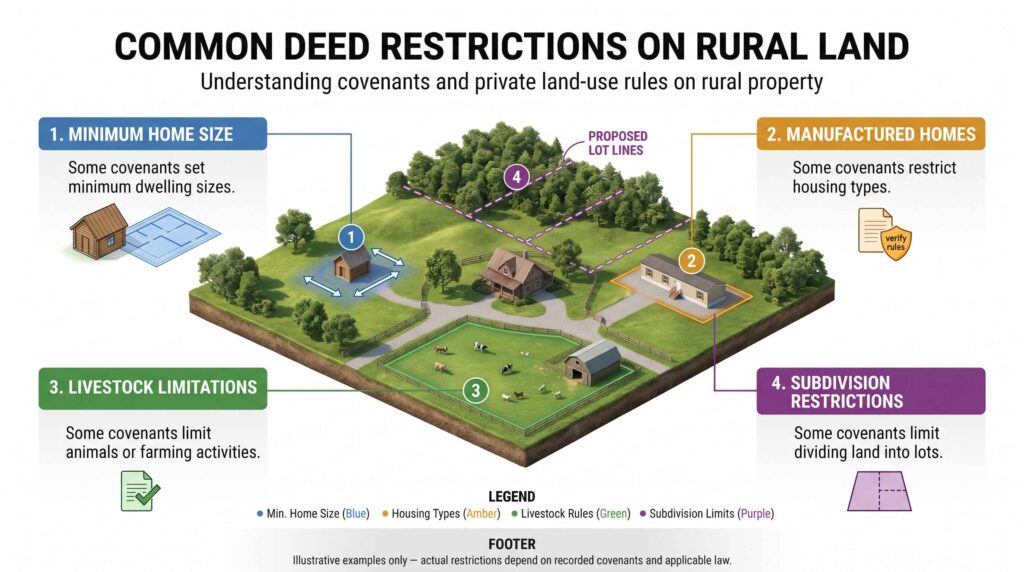
Minimum home size
A recorded covenant may establish a minimum floor area for new homes.
This could affect plans for a tiny house, small cabin, or other compact dwelling.
Manufactured and mobile homes
Some private restrictions address manufactured housing, mobile homes, or particular construction methods.
Buyers should verify both the covenant and applicable laws rather than assume that a housing type is permitted or prohibited.
Livestock and agricultural activities
A restriction may limit certain animals, agricultural operations, or related structures.
This can be especially important for buyers planning a hobby farm or homestead.
Commercial activities
Some covenants restrict business operations, outdoor storage, or other nonresidential activities.
The actual language matters, particularly for home-based businesses and agricultural enterprises.
Subdivision
A restriction may limit the division of a parcel into smaller lots.
This can affect buyers who intend to sell part of the acreage later.
Building materials and design
Some restrictions establish requirements for exterior materials, building appearance, fencing, or accessory structures.
Recreational use
Certain documents may regulate camping, recreational vehicles, temporary structures, or other activities.
Tree removal and land clearing
Some private agreements may restrict vegetation removal or require the preservation of designated areas.
Important: These are examples of possible restrictions, not rules that apply to every rural property.
The only reliable approach is to examine the actual documents affecting the specific parcel.
4. Start With the Current Deed
A useful first step is obtaining the property’s current recorded deed.
Depending on the state, deeds may be available through the county recorder, register of deeds, county clerk, or another land records office.
The deed can help identify the property, establish its legal description, and reveal references to earlier instruments.
What to look for
Review the deed for terms such as:
- Restrictions.
- Covenants.
- Conditions.
- Reservations.
- Subject to.
- Declaration.
- Book and page.
- Instrument number.
A deed may refer to a separately recorded declaration without reproducing its complete terms.
For example, the deed might state that the property is subject to restrictions recorded under an earlier instrument number.
That reference is a reason to obtain the original instrument.
Do not assume the current deed contains every applicable restriction.
Practical research tip
Save a copy of the current deed and record the instrument numbers or book-and-page references for any documents it identifies.
These references can help a title professional or attorney trace the relevant records.
5. Search for Recorded CC&Rs and Earlier Documents
CC&Rs may establish rules affecting a group of properties or a particular subdivision.
They can exist even when the development does not have an obvious gated entrance or active neighborhood association.
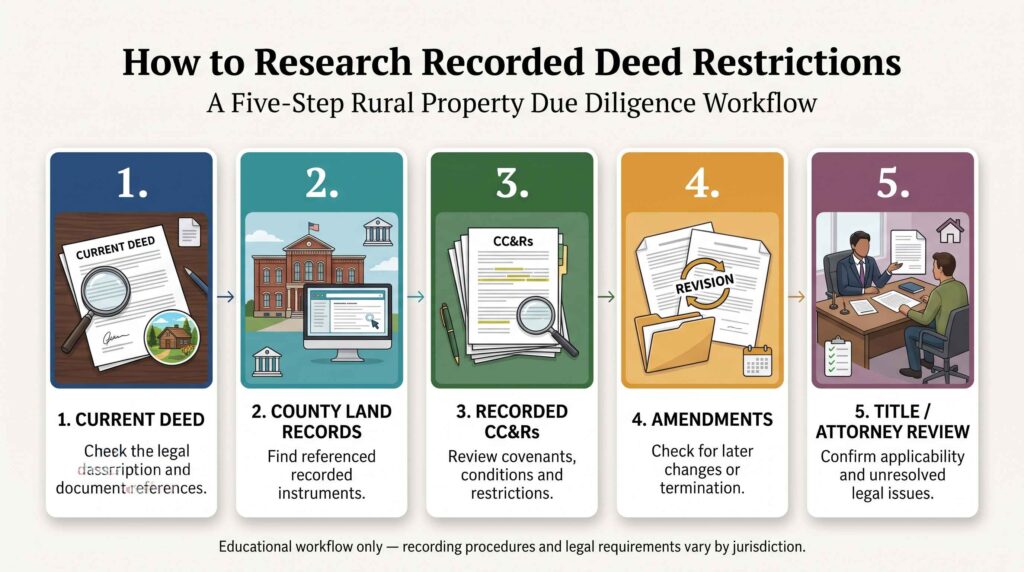
Step-by-step research process
Step 1: Identify the correct county.
Use the property’s legal location.
Step 2: Search the current deed.
Find the recorded document and its references.
Step 3: Follow the referenced instruments.
Obtain any declarations, restrictions, amendments, or supplemental agreements.
Step 4: Review the property description.
Confirm that the document actually applies to the parcel being purchased.
Step 5: Look for amendments.
A restriction may have been modified, supplemented, or terminated by a later instrument.
Step 6: Request professional review.
Ask the title company or a qualified real estate attorney to help identify relevant documents and unresolved issues.
Why searching only the current owner’s name may be insufficient
Some restrictions were recorded by a developer or former landowner decades ago.
The documents may be indexed under names that do not appear in the current listing.
A professional title examination can help identify relevant instruments through the chain of title.
6. Review the Title Commitment Carefully
A title commitment or preliminary title report can be an important source of information about recorded restrictions.
Depending on the form and jurisdiction, the document may identify restrictive covenants and other matters as exceptions to proposed title insurance coverage.
However, a title commitment is not a complete explanation of every restriction or its legal enforceability.
Questions to ask
- Are restrictive covenants identified in the title commitment?
- Which recorded instruments contain them?
- Can the title company provide complete copies?
- Have any restrictions been amended or terminated?
- Are there relevant title insurance exceptions?
- Does the proposed policy address the particular concern?
- Are additional documents or legal opinions needed?
Do not assume that title insurance guarantees permission to build a particular home or operate a particular business.
Coverage depends on the policy, endorsements, exceptions, and circumstances.
The title company and a qualified attorney can explain the scope of the proposed coverage.
7. Check Whether an HOA or Property Owners Association Exists
Some rural properties are part of communities with homeowners associations or property owners associations.
Others have recorded covenants without an active association.
The absence of monthly dues does not automatically mean that no private restrictions exist.
What buyers should request
If an association is involved, request available copies of:
- Recorded CC&Rs.
- Bylaws and governing documents.
- Rules and regulations.
- Amendments.
- Current dues and assessments.
- Relevant architectural review requirements.
- Information about known violations or pending disputes.
Ask whether approvals are required before constructing a home, installing a fence, clearing land, or adding an outbuilding.
A rural property without an HOA
Even if there is no association, recorded restrictions may still affect the property.
Depending on the documents and law, certain neighboring owners or other parties may have enforcement rights.
This is one reason to review the instruments rather than relying only on the HOA status shown in a listing.
8. Verify Cabin, Tiny Home, and Manufactured Home Plans
Buyers often purchase rural land with a specific type of home in mind.
That plan should be investigated before closing.
A property may appear spacious enough for a cabin, but the recorded covenants could establish building requirements.
Possible restrictions include minimum dwelling size, approved materials, permanent foundation requirements, or limits on temporary structures.
Before purchasing for a future cabin
- Identify the intended type of dwelling.
- Obtain the complete recorded restrictions.
- Review any minimum size or design requirements.
- Confirm whether architectural approval is necessary.
- Check local zoning and building codes separately.
- Investigate septic, water, utility, and access feasibility.
- Obtain written clarification from the appropriate authority or rights holder where possible.
A seller’s statement that other owners have built similar cabins is useful background, but it does not establish that your proposed design will be allowed.
For more information, read Can You Build a House on Cheap Rural Land?.
9. Investigate Livestock, Farming, and Homesteading Restrictions
A property described as rural or agricultural may still have private restrictions affecting its use.
Buyers planning chickens, goats, horses, cattle, or small-scale farming should check the relevant documents.
Possible restrictions may concern:
- Types or numbers of animals.
- Barns and other accessory structures.
- Commercial agricultural activities.
- Outdoor equipment storage.
- Fencing.
- Waste management.
- Land clearing.
The precise terms matter.
For example, a restriction on commercial livestock operations may raise different questions from one addressing all livestock.
Buyers should also verify applicable zoning, health, environmental, and agricultural regulations.
Buyer takeaway: A rural location does not automatically establish a legal right to operate every type of homestead or farm.
10. Check Restrictions Before Subdividing or Reselling Land
Large rural parcels can attract buyers interested in future subdivision.
A 50-acre property might appear capable of being divided into several smaller lots.
However, private covenants may limit subdivision, require minimum lot sizes, or establish other conditions.
Government subdivision rules can impose separate requirements.
Questions worth investigating
- Does a recorded covenant prohibit subdivision?
- Is a minimum parcel size required?
- Are approvals from private parties necessary?
- Does local zoning allow the proposed lot sizes?
- Will every proposed lot have legal access?
- Can utilities and wastewater systems be provided?
- Are there additional platting or permitting requirements?
A property should not be valued on the assumption that it can be divided without verifying these issues.
11. Understand Whether Deed Restrictions Can Be Changed
Some buyers assume an inconvenient restriction can simply be removed after purchasing.
That is risky.
A recorded covenant may include procedures for amendment or termination.
Those procedures may require approval from specified parties, property owners, or an association.
Other situations may involve legal questions about expiration, enforceability, changed circumstances, or applicable statutes.
The outcome varies by jurisdiction and facts.
What to investigate
- Does the document contain an expiration date?
- Does it renew automatically?
- Is there a formal amendment procedure?
- Who has authority to approve changes?
- Have previous amendments been recorded?
- Is there an existing dispute?
- What does a qualified local attorney advise?
Do not rely on an informal promise that a restriction will be waived.
If a proposed use depends on obtaining an amendment or approval, investigate whether it can be completed before closing.
12. Understand That Not Every Recorded Restriction Is Enforceable
The presence of restrictive language in a historical deed does not automatically mean that every clause can be legally enforced today.
Enforceability may depend on applicable statutes, court decisions, the language of the instrument, and the rights of the parties involved.
An especially important example concerns discriminatory covenants.
Historical deeds sometimes contain provisions that attempted to restrict ownership or occupancy based on race or other protected characteristics.
Discriminatory housing restrictions of this kind are not enforceable under applicable federal civil rights protections.
The U.S. Department of Housing and Urban Development explains that the Fair Housing Act prohibits housing discrimination based on race, color, national origin, religion, sex, familial status, and disability.
Source: HUD — Housing Discrimination Under the Fair Housing Act.
The continued appearance of unlawful language in an old recorded document does not make it legally valid.
For other types of covenants, buyers should not independently assume a restriction is unenforceable merely because it is old or has not recently been enforced.
Consult a qualified real estate attorney when enforceability is uncertain.
13. Watch for Red Flags in Property Listings
A property listing can be useful for discovering land, but it is not a substitute for title research.
Pay particular attention to statements such as:
“Unrestricted land.”
Ask what research supports this description and whether recorded covenants have been reviewed.
“No HOA.”
This does not necessarily establish that the property is free from private restrictions.
“Build your dream cabin.”
Verify the proposed building type, local permits, and recorded requirements.
“Perfect for a homestead.”
Check livestock, agricultural, and accessory structure restrictions.
“Potential to subdivide.”
Confirm both private covenants and government subdivision requirements.
“Buyer to verify restrictions.”
Treat this as an explicit reminder to complete your own due diligence.
The objective is not to distrust every listing.
It is to distinguish marketing language from documented property rights.
14. A Practical Comparison of Two Hypothetical Properties
Consider two fictional 40-acre rural properties.
Both have forested land, a gravel driveway, and attractive locations for a small cabin.
Property A
The buyer obtains a title commitment and copies of the relevant recorded instruments.
The documents identify a minimum dwelling size and certain restrictions on exterior construction materials.
The buyer’s proposed 1,200-square-foot cabin may be compatible, but the exact design and approval requirements still need verification.
Property B
The listing describes the land as unrestricted.
However, the buyer has not yet obtained a title commitment or reviewed the recorded chain of title.
The seller believes no restrictions apply, but there is no documentation confirming that conclusion.
| Due diligence question | Property A | Property B |
|---|---|---|
| Acreage | 40 acres | 40 acres |
| Listing description | Rural residential land | Advertised as unrestricted |
| Recorded documents | Obtained | Not yet reviewed |
| Known private restrictions | Building-related covenants | Unknown |
| Proposed cabin suitability | Requires design verification | Cannot yet be determined |
| Main next step | Confirm compliance and approvals | Complete title and records research |
Property A has known limitations, but the buyer has information to evaluate them.
Property B may ultimately have fewer restrictions, yet the uncertainty remains until the relevant records are reviewed.
The lesson: A property with documented restrictions can be easier to evaluate than a supposedly unrestricted property with incomplete records.
This example is fictional and does not describe actual properties.
15. Deed Restrictions Due Diligence Checklist
Before purchasing rural land, use this checklist to organize your research.
- Obtain the property’s current recorded deed.
- Confirm the legal description.
- Request a title commitment or preliminary title report.
- Identify references to covenants, conditions, and restrictions.
- Obtain complete copies of referenced instruments.
- Search for recorded amendments and supplemental declarations.
- Confirm that the restrictions apply to the parcel.
- Investigate whether an HOA or property owners association exists.
- Review building size and design requirements.
- Check rules affecting cabins, tiny homes, and manufactured homes.
- Investigate livestock and agricultural restrictions.
- Check camping, RV, and temporary structure rules.
- Review subdivision restrictions.
- Check maintenance obligations and assessments.
- Confirm local zoning requirements separately.
- Review easements and legal access separately.
- Ask about known violations or disputes.
- Obtain legal advice for unclear or potentially unenforceable provisions.
- Resolve important approval questions before closing.
Where appropriate, discuss title review and land-use feasibility contingencies with a qualified real estate attorney or agent before signing a purchase agreement.
Frequently Asked Questions
What is a deed restriction?
A deed restriction is a private legal limitation or obligation affecting how property may be used. It may appear in a deed or a separately recorded instrument.
Can deed restrictions apply to rural land without an HOA?
Yes. Private covenants may affect rural property even when no homeowners association exists.
Do deed restrictions expire when a property is sold?
Not necessarily. Some enforceable covenants run with the land and can continue to affect future owners.
Can I build a tiny home on land with deed restrictions?
It depends on the restrictions, applicable law, and the proposed dwelling. Buyers should also verify zoning and building requirements.
Are deed restrictions the same as zoning laws?
No. Deed restrictions generally arise from private legal arrangements, while zoning rules are government regulations.
How do I find deed restrictions on a property?
Start with the current deed, county land records, title commitment, and any referenced CC&Rs or amendments. A title professional or attorney can help with more complex research.
Can I remove a deed restriction?
Possibly, but the process depends on the document, applicable law, and parties with enforcement rights. Removal should never be assumed.
Does a title report list every restriction?
A title report can identify important recorded matters, but its contents and limitations vary. Buyers should review the underlying documents and ask about unresolved issues.
Can deed restrictions prohibit livestock?
Some covenants may restrict particular animals or agricultural activities. The actual wording and applicable law determine the effect.
Does “unrestricted land” mean I can build anything?
No. Even without private deed restrictions, zoning, building codes, environmental regulations, septic requirements, and other laws may apply.
Final Thoughts
Deed restrictions are an important part of rural land due diligence.
They can affect building plans, farming activities, property improvements, subdivision opportunities, and future use.
Some restrictions may be minor or compatible with a buyer’s goals.
Others may make a particular development plan impractical.
The most useful approach is to obtain the recorded documents, review the title information, compare the restrictions with your intended use, and seek professional guidance when necessary.
Before buying rural land, verify not only what the property physically offers, but also what its legal restrictions actually allow.
Editorial Disclaimer: This article provides general educational information about deed restrictions and rural property research in the United States. It does not constitute legal, title insurance, surveying, or real estate advice. Property laws, covenant enforceability, recording procedures, and land-use regulations vary by state and circumstances. Consult a qualified local real estate attorney, title professional, and relevant government authorities before purchasing or developing a specific property.
