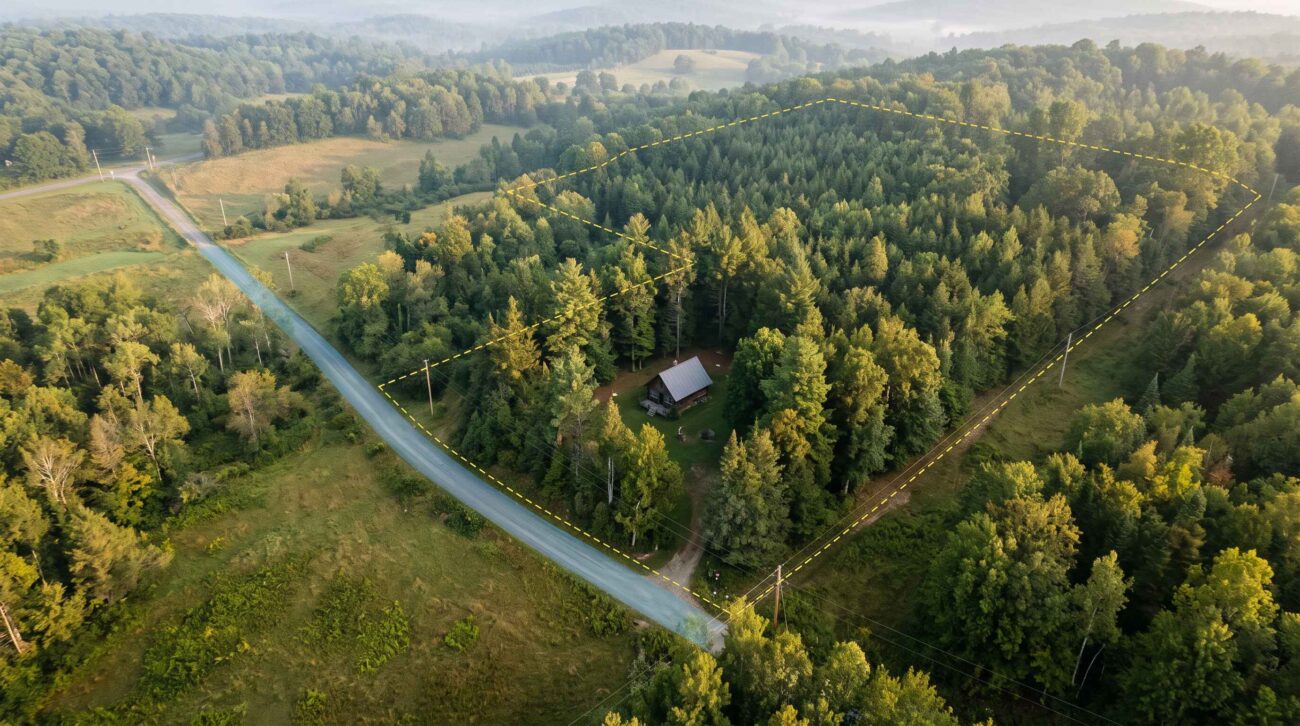
A secluded 35-acre property with wooded hills, a small creek, and a gravel driveway may look like the perfect place to build a cabin.
The listing photographs show privacy. The property description mentions road access. The acreage appears to offer plenty of room for future improvements.
But there may be legal rights affecting the land that are not visible in the photographs.
A neighboring landowner might have a recorded right to use part of the driveway. A utility company may have permission to access an underground pipeline. Or the only practical route to the property may cross land owned by someone else.
These arrangements often involve easements.
An easement is not automatically a problem. Some easements provide essential access or utility connections. Others may limit where improvements can be placed or create ongoing responsibilities.
Before buying rural land, buyers should understand which easements benefit the property, which ones burden it, and what the relevant documents actually allow.
This guide explains how to research easements, review title documents, evaluate surveys, identify possible restrictions, and ask the right questions before closing.
1. What Is an Easement?
An easement is a legal right allowing someone to use another person’s land for a particular purpose, without necessarily owning that land.
For example, an easement might allow a neighboring property owner to travel across a designated driveway.
Another easement might permit a utility company to install, inspect, or maintain electrical equipment.
The underlying property owner generally retains ownership, but that ownership is subject to the applicable easement rights.
The specific rights and restrictions depend on the easement’s legal basis, wording, and governing state law.
The American Bar Association explains that easements can affect access, utilities, shared driveways, and other property uses.
Source: American Bar Association — Residential Real Estate FAQs.
Why this matters for rural buyers
An easement can affect:
- Access to public roads.
- The location of future buildings.
- Driveway use and maintenance.
- Utility installation and repairs.
- Fencing and gates.
- Privacy and vehicle traffic.
- Future subdivision plans.
- The use of certain parts of the land.
Buyer takeaway: Owning a large parcel does not necessarily mean every portion can be used without restrictions.
2. Understand Easements That Benefit or Burden the Property
One of the most important distinctions is whether an easement benefits the land you are buying or places obligations and restrictions on it.
Easement benefiting your property
Suppose a rural parcel has no direct connection to a public road.
A recorded easement across a neighboring parcel may provide a legal route to reach the property.
In this situation, the easement benefits the land you are purchasing.
Easement burdening your property
Now suppose a neighbor has a recorded right to cross a strip of the property you intend to purchase.
The easement burdens your land because another party has rights affecting that area.
Can both apply?
Yes.
A rural property might benefit from an access easement over one neighbor’s land while also being burdened by a utility easement or another neighbor’s access rights.
| Easement relationship | Example | Buyer concern |
|---|---|---|
| Benefits the property | Access across neighboring land | Confirm that the legal rights are sufficient for intended use |
| Burdens the property | Neighbor’s driveway across the parcel | Understand permitted use and restrictions |
| Both | Shared access arrangement | Review rights and obligations affecting each property |
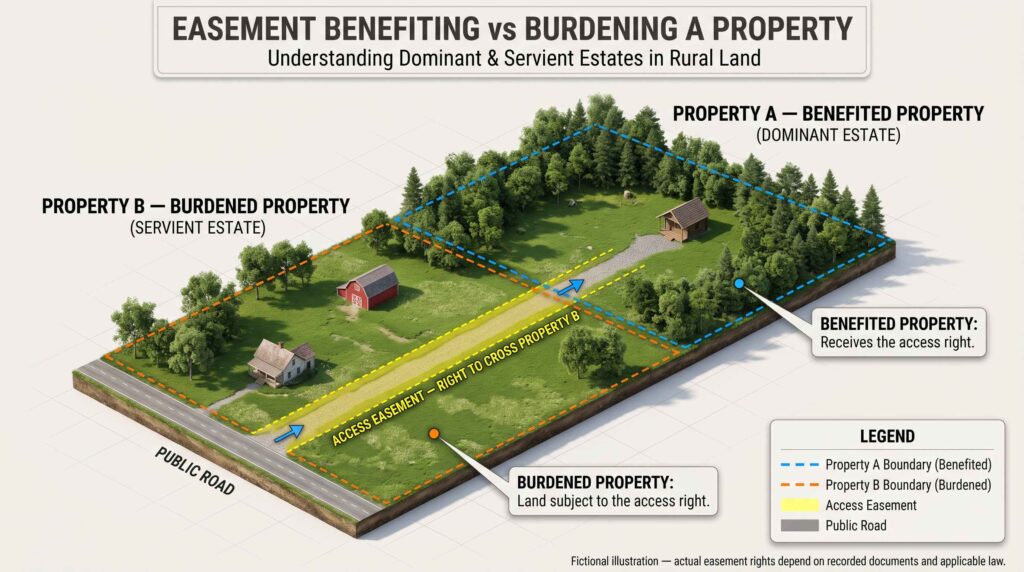
The American Bar Association describes these concepts using the terms dominant estate for benefited land and servient estate for burdened land.
Source: American Bar Association — Residential Real Estate FAQs.
3. Learn the Common Types of Rural Property Easements
Different easements serve different purposes.
Access and right-of-way easements
These may permit vehicles or pedestrians to cross another property.
The document may define the route, width, permitted users, and authorized activities.
Do not assume that every access easement permits heavy construction equipment, commercial traffic, or widening a road.
Utility easements
Utility companies or other authorized parties may have rights to install, operate, inspect, repair, or replace infrastructure.
These can involve electricity, water, sewer lines, gas pipelines, or telecommunications.
Shared driveway easements
Two or more properties may rely on the same driveway.
The legal arrangement may address use, maintenance, and cost sharing.
Drainage easements
Certain easements may protect drainage channels or permit water-related infrastructure and maintenance.
Conservation easements
A conservation easement may restrict certain development or land uses to protect conservation values.
Its restrictions can be significant and may continue to apply to future owners.
Other easement arrangements
Depending on state law and property history, buyers may encounter easements associated with agricultural operations, water access, pipelines, or other specialized purposes.
Important: The easement’s name alone does not establish its complete legal effect. Read the actual governing document.
4. Start With the Title Commitment or Preliminary Title Report
One of the most useful documents to review during a property purchase is the title commitment or preliminary title report.
Terminology and format vary by state and title company.
These documents may identify recorded easements, rights-of-way, restrictions, and other matters affecting title.
In an ALTA-style title commitment, buyers may encounter:
Schedule A: Information identifying the proposed insured interest and related matters.
Schedule B: Requirements or exceptions, depending on the applicable subsection and document format.
Easements benefiting a property and easements burdening it may appear in different parts of the title documentation.
Do not rely on a brief summary alone.
Ask the title company for copies of the underlying easement documents referenced in the report.
Questions to ask the title company
- Which easements benefit this property?
- Which easements burden it?
- Are the easements recorded?
- Are copies of the relevant instruments available?
- Are any access rights excluded from proposed title coverage?
- Are there survey-related exceptions?
- Are additional endorsements available or appropriate?
The American Land Title Association’s survey guidance addresses the relationship between recorded documents, title information, and survey findings.
Source: ALTA — Land Title Survey Standards.
5. Search County Land Records for Recorded Easements
Many easements are documented in public land records.
Depending on the state and county, these records may be maintained by a recorder, register of deeds, county clerk, or another office.
Some counties provide searchable online databases.
Others require requests, fees, or in-person research.
Practical research process
Step 1: Identify the correct county.
Use the property’s legal location rather than relying only on its mailing address.
Step 2: Obtain the legal description.
The deed and title documents may contain descriptions needed to locate relevant records.
Step 3: Review the current deed.
Look for references to easements, rights-of-way, reservations, and prior recorded instruments.
Step 4: Search referenced documents.
Record book and page numbers, instrument numbers, and recording dates may help locate the actual agreements.
Step 5: Review relevant neighboring parcels.
An easement benefiting your property may be documented in records associated with the land it crosses.
Step 6: Ask for professional help where needed.
A title company or real estate attorney can help interpret the record chain and identify unresolved issues.
Important limitation
Not every easement or claimed property right is necessarily revealed by a simple online search.
Some rights may arise through legal doctrines involving prior use, necessity, prescription, or other state-specific circumstances.
Do not conclude that an easement cannot exist merely because an online county search did not reveal a recorded document.
6. Read the Actual Easement Agreement
A title report may identify an easement without explaining every practical detail.
The underlying agreement is often where the important terms appear.
Buyers should review the document with particular attention to the following questions.
What is the easement for?
Is the purpose limited to residential access, utilities, agricultural operations, or another specified activity?
Where is it located?
Does the document identify a fixed route or defined area?
Does it include a legal description, survey exhibit, or referenced map?
How wide is it?
A recorded width may matter for vehicle access, utility construction, or future improvements.
However, the usable width on the ground may be affected by terrain, drainage, vegetation, or existing structures.
Who can use it?
The agreement may identify particular owners, properties, companies, or classes of authorized users.
Who maintains it?
Check whether the agreement allocates maintenance obligations or expenses.
Do not assume that a neighbor, county, or utility provider will automatically pay for repairs.
Can the easement be changed or terminated?
The answer depends on the agreement, applicable law, and circumstances.
An easement should not be treated as temporary merely because it is rarely used.
Buyer takeaway: A legal easement can be valuable, but its exact wording determines whether it supports your intended plans.
7. Use a Property Survey to Understand Easement Locations
A professional land survey can help buyers understand how documented easements relate to the physical property.
Depending on the survey’s scope and available documents, it may show easement locations, boundaries, buildings, driveways, fences, and other relevant features.
This is particularly important when planning a cabin, barn, driveway, fence, or utility installation.
The 2026 ALTA/NSPS Land Title Survey Standards address survey-related easement information and the relationship between field observations and title documents.
These standards took effect on February 23, 2026.
Source: ALTA — 2026 Land Title Survey Standards.
What to verify
- Does the easement cross the intended building site?
- Is the driveway inside the documented access area?
- Are existing structures located within easement areas?
- Are there utility corridors affecting planned improvements?
- Does the survey match the relevant recorded documents?
- Are there apparent roads or paths that require further legal investigation?
A survey is not a complete legal opinion
Surveyors can locate and depict relevant physical and documentary information within their scope of work.
However, questions about the legal validity, interpretation, enforceability, or termination of easements may require a real estate attorney.
Also, an ordinary boundary survey is not automatically equivalent to an ALTA/NSPS Land Title Survey.
Ask the surveyor which services are appropriate for the transaction.
For more information, see How to Check Property Boundaries Before Buying Rural Land.
8. Verify Legal Road Access Separately From Physical Access
A visible gravel road is not proof that a buyer has an enforceable right to use it.
A driveway may cross privately owned land.
The route might depend on permission from a neighbor, an easement, or another legal arrangement.
Some routes are maintained privately even when they are legally accessible.
Questions to investigate
- Does the property directly touch a public road?
- If not, what legal instrument provides access?
- Does the route reach the property continuously?
- Is the easement suitable for the intended use?
- Are gates or other access restrictions involved?
- Who is responsible for maintenance?
- Are there seasonal or weather-related limitations?
- Can emergency vehicles reasonably reach the intended home site?
Legal access and practical vehicle access are different questions.
A recorded right-of-way does not guarantee that a steep, muddy, or washed-out road is passable.
Read our separate guide: Legal Road Access When Buying Rural Land.
9. Understand How Utility Easements Can Affect Development
Utility easements may provide essential infrastructure access, but they can also affect land-use plans.
For example, an electric utility easement may allow a company to access lines and maintain a corridor.
Depending on the agreement and applicable regulations, certain structures, trees, excavation, or other activities may be restricted.
An underground pipeline easement may also require additional planning before digging or constructing improvements.
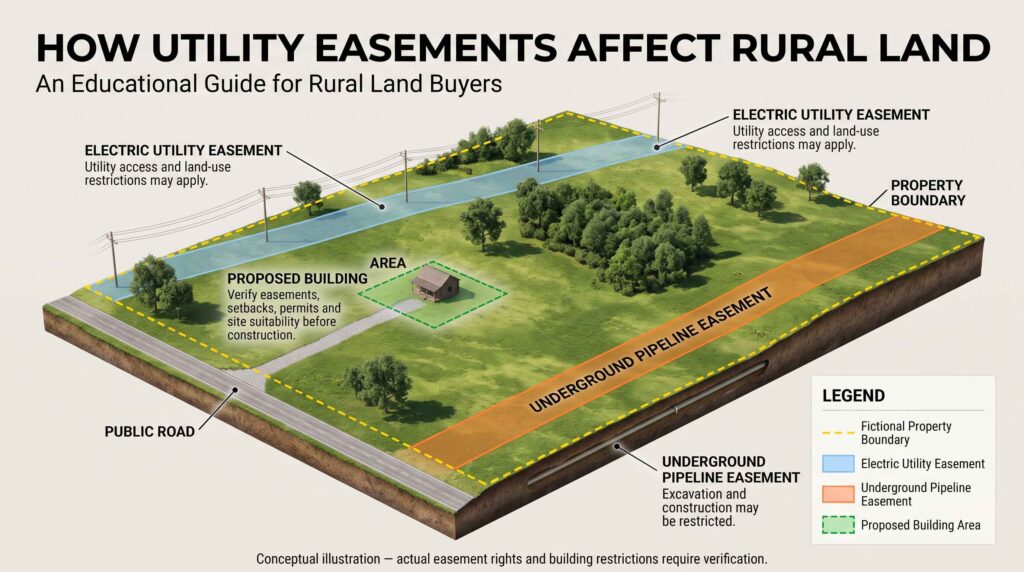
Before building near a utility easement
- Obtain the recorded easement agreement.
- Identify the affected area on an appropriate survey.
- Confirm the utility provider or rights holder.
- Ask about applicable construction and vegetation restrictions.
- Check local building requirements.
- Obtain any necessary approvals before proceeding.
Do not assume that a utility easement guarantees the utility company will connect service to the property.
An easement providing a utility corridor and the availability of an actual service connection are separate matters.
For additional research, see Rural Property Utilities Checklist.
10. Check Maintenance and Shared Road Responsibilities
Private roads can create expenses that are easy to overlook.
Even when an easement clearly establishes a right of access, the agreement may not provide a simple answer about road maintenance.
Buyers should investigate who is responsible for grading, gravel, drainage, culverts, vegetation removal, and snow clearing.
A written maintenance agreement may allocate responsibilities among the properties using the road.
However, not every property has such an agreement.
Ask these questions before closing
- Is there a recorded road maintenance agreement?
- Which properties share the road?
- How are costs divided?
- Who arranges repairs?
- What happens when a property owner does not contribute?
- Are there existing drainage or erosion problems?
- Will future construction traffic require road improvements?
Do not rely solely on informal statements that neighbors have always maintained the road together.
A real estate attorney can help determine the legal obligations that apply.
11. Look for Unrecorded or Disputed Easement Claims
Some rural property disputes involve long-standing patterns of use.
For example, a neighbor may have used a trail across the property for many years.
Another property owner may claim that a historical access route is legally protected.
Whether such use creates an enforceable right depends on state law and specific facts.
Possible issues include:
- Claimed prescriptive easements.
- Easements by necessity.
- Easements implied from prior use.
- Disputes over the location of an existing easement.
- Unrecorded agreements.
- Differences between a recorded route and the route actually used.
These are legal questions, not matters that can be resolved from aerial photographs alone.
Warning signs
Pay attention to visible tracks crossing the property, gates used by others, unexplained utility infrastructure, and seller statements about informal access arrangements.
These signs do not prove an easement exists.
They do indicate that further investigation may be worthwhile.
Ask the seller directly about any known disputes or third-party uses and consult an appropriate attorney when necessary.
12. Review Easements Before Planning Improvements
A rural property may have enough acreage for a house, barn, workshop, or driveway, but an easement can influence where those improvements may be placed.
Before spending money on plans, compare the proposed development area with the survey and recorded restrictions.
For example, a utility corridor might cross the most convenient building location.
A shared driveway may limit where a gate or fence can be installed.
A conservation easement may impose broader land-use restrictions.
Development planning checklist
- Identify the intended building site.
- Locate recorded easements.
- Review applicable setback and zoning rules.
- Confirm legal and practical access.
- Investigate utility corridor restrictions.
- Check whether grading or excavation is allowed.
- Ask about required approvals.
- Review future subdivision plans with qualified professionals.
An easement is only one part of land development due diligence.
Also see How to Check Zoning Before Buying Rural Land.
13. A Practical Example: Two Hypothetical Rural Properties
Consider two fictional rural parcels, each containing 40 acres.
Both are advertised as private wooded properties suitable for a future cabin.
Property A
Property A connects directly to a public road.
Its title documents identify a utility easement along one boundary.
A survey shows the utility corridor away from the proposed building area.
The buyer still needs to review the agreement and confirm construction requirements, but the location is documented.
Property B
Property B is reached by a gravel road crossing two neighboring parcels.
The seller states that the road has been used for decades.
However, the buyer has not yet received recorded access documents, a maintenance agreement, or a survey confirming the route.
| Due diligence factor | Property A | Property B |
|---|---|---|
| Acreage | 40 acres | 40 acres |
| Road access | Direct public-road frontage | Gravel road across neighboring land |
| Easement documents | Utility easement identified | Access documents not yet verified |
| Survey information | Easement location shown | Access route needs investigation |
| Main concern | Restrictions near utility corridor | Legal access and maintenance uncertainty |
| Recommended next step | Confirm utility restrictions | Obtain title, survey, and legal review |
Property B is not necessarily a bad purchase.
A valid access easement may exist, and the road may be perfectly usable.
However, the buyer should establish those facts before relying on the route.
The lesson: Two properties with identical acreage can have very different legal access and land-use considerations.
This example is fictional and does not describe actual properties.
14. Easement Due Diligence Checklist for Rural Buyers
Use this checklist before completing a rural land purchase.
- Obtain the current deed and legal description.
- Request the title commitment or preliminary title report.
- Identify easements that benefit the property.
- Identify easements that burden the property.
- Obtain copies of referenced recorded easement documents.
- Confirm the easement purpose and authorized users.
- Check the described location and width.
- Review the permitted uses and restrictions.
- Verify access to a public road.
- Investigate private road maintenance responsibilities.
- Review relevant utility easements.
- Obtain an appropriate survey when needed.
- Compare easement locations with proposed building areas.
- Ask about unrecorded uses and disputes.
- Confirm whether title insurance covers relevant access rights.
- Discuss unresolved issues with a qualified real estate attorney.
- Resolve significant questions before closing.
Where appropriate, buyers should discuss title, survey, and access contingencies with their attorney or real estate agent before committing to a purchase.
Frequently Asked Questions
What is an easement on rural property?
An easement is a legal right that permits a person or entity to use another person’s land for a defined purpose, such as access or utilities.
Does an easement mean someone else owns my land?
Not necessarily. The property owner generally retains ownership, subject to the applicable easement rights.
Can I build on land affected by an easement?
It depends on the easement terms, intended construction, and applicable laws. Obtain professional guidance before building in an easement area.
Does a gravel driveway prove legal access?
No. A visible driveway does not by itself establish a legally enforceable right to cross someone else’s land.
Are easements always recorded?
No. Certain easement claims may arise without a recorded agreement, depending on state law and the circumstances.
Can an easement be removed?
Sometimes, but termination depends on the type of easement, governing documents, applicable law, and relevant facts. Do not assume an easement can be removed unilaterally.
Does a survey show every easement?
Not necessarily. A survey’s contents depend on its scope and the documents available. Some legal rights may require additional title research or legal analysis.
Who pays to maintain an easement road?
Responsibilities may be addressed in recorded agreements or applicable law. Buyers should verify the obligations rather than assume costs are shared equally.
Does title insurance cover easement disputes?
Coverage depends on the specific policy, endorsements, exceptions, and facts. Ask the title insurer to explain what is and is not covered.
Final Thoughts
Easements are an important part of rural property due diligence.
They can provide essential access, support utility services, or protect certain land uses.
They can also affect privacy, development plans, road maintenance, and the practical use of a property.
The safest approach is to review the recorded documents, examine the title commitment, obtain an appropriate survey, and seek legal advice when important questions remain.
A beautiful parcel with a visible driveway is not necessarily free of access concerns.
Likewise, a property with a recorded easement is not automatically unsuitable.
The goal is to understand the rights attached to the land before making a purchase decision.
Editorial Disclaimer: This article provides general educational information about easements and rural property research in the United States. It is not legal, surveying, title insurance, or real estate advice. Easement rights, recording procedures, access requirements, and property laws vary by state and circumstances. Consult a qualified local real estate attorney, title professional, and licensed surveyor before relying on an easement or completing a property purchase.
