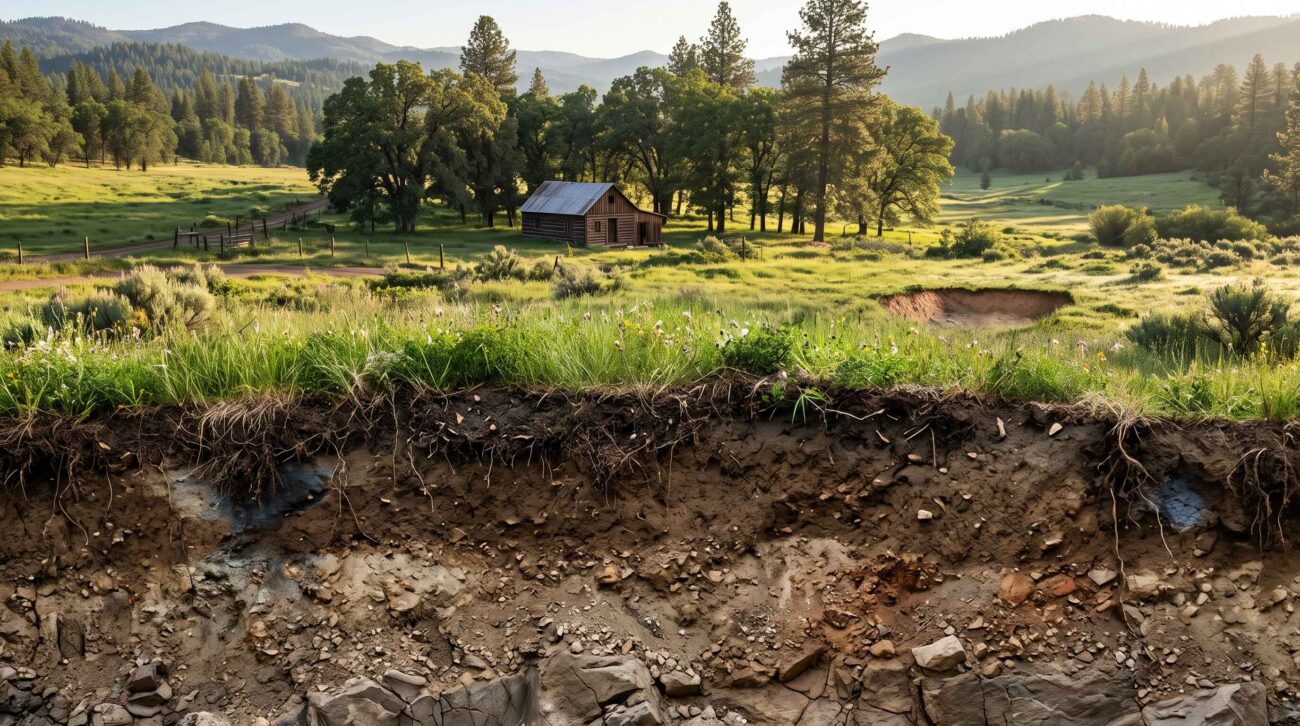
A beautiful 40-acre rural property may have everything a buyer wants: wooded hills, open meadows, privacy, and enough space for a future cabin or homestead.
But there is something the listing photos cannot reveal.
The soil beneath that landscape could affect where a house can be built, whether a septic system is feasible, how well the land drains, and whether a garden or small farm can thrive.
Two properties with similar acreage and scenery may have very different soil conditions.
One might have deep, well-drained soils suitable for certain agricultural uses. Another might contain shallow bedrock, seasonal wetness, severe erosion, or compacted ground.
Neither property should be judged by appearance alone.
Before purchasing rural land, buyers should research the soil’s characteristics, understand potential limitations, and determine which professional evaluations are necessary for their intended use.
This guide explains how to investigate soil conditions using the USDA Web Soil Survey, recognize common warning signs, understand different soil tests, and make more informed decisions before closing.
1. Understand What Soil Quality Really Means
Soil quality is not simply a measure of whether land looks fertile.
Different land uses require different soil characteristics.
For example, soil that supports healthy pasture may not necessarily be suitable for a conventional septic drainfield.
Similarly, a property with excellent garden soil may still have foundation challenges in a particular building area.
The USDA Natural Resources Conservation Service (NRCS) evaluates soil health using physical, chemical, and biological indicators rather than relying on a single measurement.
These indicators can include organic matter, soil structure, water infiltration, compaction, pH, and biological activity.
Source: USDA NRCS — Soil Health Assessment.
Why soil matters to rural buyers
Soil conditions can influence:
- Residential construction and foundation design.
- Septic system suitability.
- Drainage and seasonal wetness.
- Gardening and agricultural productivity.
- Driveway construction and maintenance.
- Erosion and slope stability.
- Pond construction and other land improvements.
- Long-term property management.
Buyer takeaway: The right question is not simply whether the soil is good. It is whether the soil is suitable for what you plan to do with the property.
2. Start With the USDA Web Soil Survey
One of the most useful free resources for researching American land is the USDA Web Soil Survey.
The tool provides mapped soil information and interpretations developed through the National Cooperative Soil Survey.
It can help buyers identify likely soil types, drainage characteristics, depth to restrictive layers, and potential land-use limitations.
Official tool: USDA Web Soil Survey.
How to research a property
Step 1: Open the Web Soil Survey.
Visit the official USDA website.
Step 2: Find the property.
Use the available location tools to navigate to the correct state, county, and parcel area.
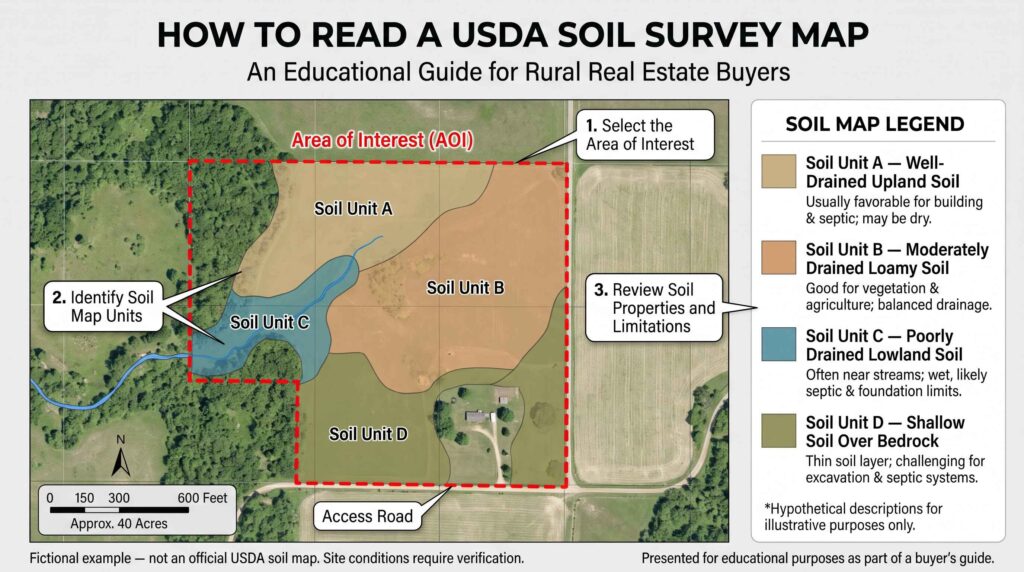
Step 3: Define the Area of Interest.
Draw an Area of Interest, or AOI, around the property or the portion you want to investigate.
Step 4: Open the Soil Map.
Review the soil map units identified within the selected area.
Step 5: Explore Soil Data.
Look for soil properties and interpretations relevant to your intended use, such as drainage, depth to bedrock, flooding frequency, and selected engineering or agricultural limitations.
Step 6: Save your findings.
Use the tool’s reporting features to preserve relevant maps and information for further discussion with local professionals.
Important limitation
USDA soil maps are valuable planning resources, but they are not a substitute for a site-specific investigation.
Mapped soil boundaries may not precisely represent conditions at a particular proposed building location.
Small variations, disturbed ground, and localized conditions may not be fully captured.
The USDA explicitly notes that on-site investigation is needed for certain engineering applications and soil quality assessments.
Source: USDA NRCS — Web Soil Survey.
3. Learn the Difference Between Sandy, Clay, Silt, and Loamy Soils
Soil texture describes the relative proportions of sand, silt, and clay.
These particles influence how soil holds water, drains, and behaves under different conditions.
| Soil characteristic | General behavior | Potential buyer consideration |
|---|---|---|
| Sandy soil | Often allows relatively rapid water movement | May have limited water and nutrient retention |
| Clay-rich soil | Can retain substantial water and may drain slowly | Wetness, shrink-swell behavior, or construction limitations may need evaluation |
| Silty soil | Often holds water and can be vulnerable to erosion | Erosion and drainage deserve attention |
| Loamy soil | Contains a mixture of particle sizes | Performance still depends on structure, drainage, and other properties |
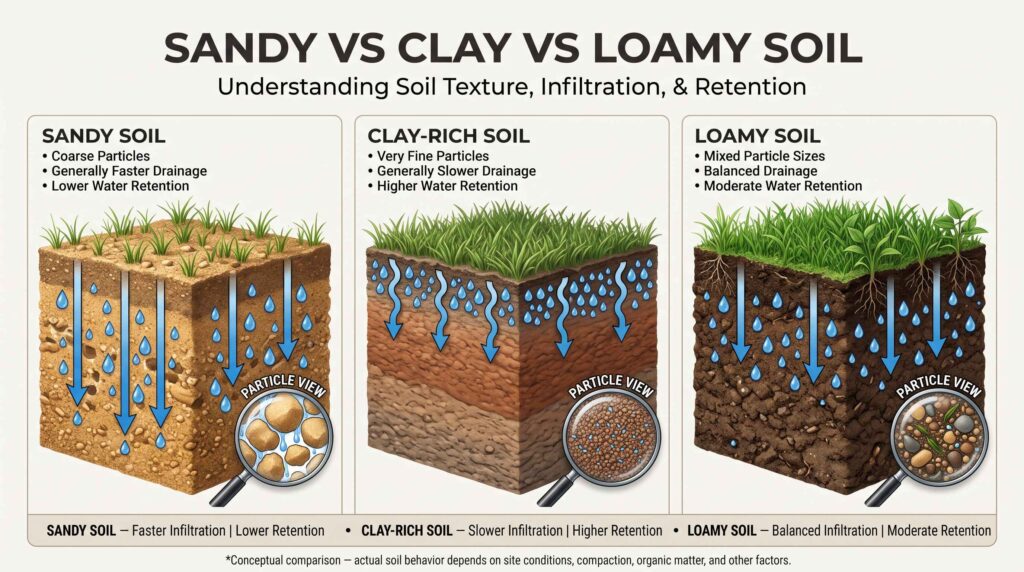
These are general descriptions, not guarantees about a particular property.
Soil structure, compaction, organic matter, slope, and underlying layers can substantially change how a site behaves.
A soil texture label alone cannot establish foundation suitability, septic approval, or agricultural productivity.
For more background, see USDA NRCS — Soil Facts.
4. Check Soil Drainage and Seasonal Wetness
Drainage is one of the most important soil-related issues for rural property buyers.
Some soils allow water to move through relatively easily.
Others may remain saturated for extended periods, particularly after heavy rain or during certain seasons.
Poorly drained areas may create problems for access roads, building sites, landscaping, and wastewater disposal.
Warning signs to investigate
- Standing water after rainfall.
- Persistent muddy areas.
- Drainage channels or erosion marks.
- Water collecting near an existing foundation.
- Vegetation associated with wet conditions.
- Signs of past flooding or sediment deposits.
These signs can provide clues, but they do not establish a formal drainage classification.
A property may appear dry during summer and experience significant seasonal wetness during other months.
Ask about historical conditions and review the relevant USDA soil descriptions.
For related research, read How to Check Flood Risk Before Buying Rural Land.
5. Investigate Depth to Bedrock and Restrictive Layers
Not every rural property has deep soil.
Some sites contain shallow bedrock, dense restrictive layers, or other subsurface conditions that affect construction and wastewater systems.
These conditions can influence excavation, foundation design, utility installation, and drainage.
For example, a rocky hillside may provide an attractive cabin setting but require additional investigation before planning a foundation or septic system.
USDA soil survey information can help identify mapped limitations.
However, a geotechnical engineer or other qualified professional may need to evaluate the actual proposed building area.
Questions to ask
- Is shallow bedrock indicated in the soil survey?
- Are restrictive layers identified?
- Has the property undergone previous excavation?
- Are there existing soil or geotechnical reports?
- Will the intended construction require additional subsurface investigation?
Avoid assuming that visible rock automatically makes land unbuildable.
The actual implications depend on the site, project design, local regulations, and professional findings.
6. Understand Soil Requirements for Septic Systems
A septic system depends on more than the presence of available land.
For many conventional systems, soil conditions play an essential role in the treatment and dispersal of wastewater.
Local authorities may require soil evaluations, site inspections, percolation tests, or other investigations.
The exact process varies by jurisdiction and proposed system.
A large property does not automatically guarantee a suitable septic area.
Likewise, a property with challenging soils may sometimes support an approved alternative system, but this requires site-specific evaluation.
Before purchasing, buyers should identify the relevant permitting authority and understand the approval process.
Read our detailed guide: Septic Requirements Before Buying Rural Land.
Important: A gardening soil test and a septic suitability evaluation serve different purposes. One cannot replace the other.
7. Evaluate Soil Conditions for Gardening and Farming
Buyers interested in homesteading, gardening, orchards, or small-scale agriculture should investigate soil fertility and management needs.
Important factors may include:
- Soil pH.
- Organic matter.
- Available plant nutrients.
- Soil texture and structure.
- Compaction.
- Drainage and water-holding capacity.
- Erosion.
- Previous land management.
A laboratory soil test can help identify certain chemical characteristics and nutrient conditions.
State cooperative extension services often provide guidance about appropriate sampling and testing for local crops and soils.
However, a routine fertility test does not automatically screen for hazardous contamination.
For example, someone planning a vegetable garden on land with a history of industrial activity, waste disposal, or other suspected contamination may need a different testing strategy.
Questions for future homesteaders
What crops do you intend to grow?
How much of the property is actually suitable for cultivation?
Is irrigation available?
Does the soil need amendments or erosion management?
Are there signs of compaction from past equipment or livestock activity?
The answers can be more useful than simply describing a property as having fertile soil.
8. Look for Erosion and Steep-Slope Limitations
Steep land can provide privacy, views, and recreational opportunities.
It can also present challenges.
Soil erosion occurs when water, wind, or other processes remove or redistribute soil.
On sloping land, concentrated runoff may create rills, gullies, and sediment movement.
Disturbed soil, poorly planned driveways, and inadequate drainage can make some problems worse.
What buyers should inspect
- Exposed soil on steep slopes.
- Existing gullies.
- Sediment accumulation below hillsides.
- Road washouts.
- Unstable-looking cut slopes.
- Drainage patterns near proposed improvements.
- Areas disturbed by previous logging or grading.
Not every steep property has severe erosion.
However, building and driveway plans should account for terrain and site-specific soil conditions.
A qualified engineer or other appropriate professional may be needed to evaluate slope stability or construction concerns.
9. Watch for Soil Compaction and Disturbed Ground
Soil compaction can reduce pore space and affect the movement of air and water.
It may also restrict plant root development.
Compaction can result from heavy machinery, repeated vehicle traffic, livestock activity, or other land uses.
Potential signs include persistent surface ponding, hard ground, restricted vegetation growth, and heavily trafficked areas.
However, these signs can have several causes.
A professional soil assessment can help distinguish compaction from other problems.
Previously disturbed land
Buyers should also investigate areas that appear to have been filled, excavated, or regraded.
Fill material may differ significantly from undisturbed natural soil.
Depending on the project, construction on filled ground may require additional engineering assessment.
A smooth, level clearing is not necessarily a verified building site.
10. Research Possible Soil Contamination
Some rural properties have histories that deserve additional environmental investigation.
Potential concerns may involve former dumping areas, fuel storage, chemical handling, mining activity, or nearby industrial uses.
The presence of an old structure or previous agricultural use does not automatically establish contamination.
However, historical land use can influence what should be investigated.
Practical steps
- Ask the seller about previous property uses.
- Review historical aerial photographs when available.
- Look for evidence of dumping, tanks, staining, or unusual debris.
- Research available state and local environmental records.
- Consult a qualified environmental professional when there are credible concerns.
The EPA describes All Appropriate Inquiries as a process for evaluating environmental conditions and potential contamination-related liability.
A Phase I Environmental Site Assessment may be appropriate for certain purchases, particularly where environmental risks or liability concerns exist.
Additional sampling may be recommended depending on the findings.
Source: EPA — Brownfields All Appropriate Inquiries.
Important: A standard agricultural soil fertility test is not the same as an environmental contamination assessment.
11. Know Which Soil Tests You Actually Need
Different soil investigations answer different questions.
| Intended purpose | Potential evaluation |
|---|---|
| Vegetable gardening | Agricultural soil fertility and pH testing |
| Residential construction | Site-specific geotechnical investigation |
| Septic system installation | Locally required soil and wastewater site evaluation |
| Drainage concerns | Soil and site drainage assessment |
| Suspected contamination | Environmental assessment and targeted laboratory testing |
| Pasture or farming | Soil health and agricultural suitability evaluation |
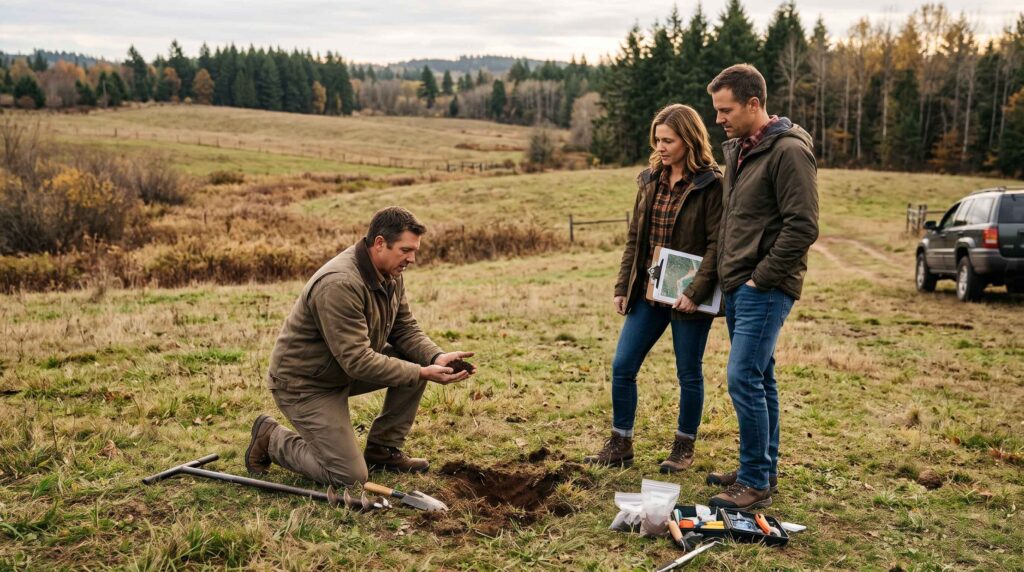
The right professional depends on the question.
A cooperative extension office may help with gardening and crop-related testing.
A geotechnical engineer may be needed for construction.
A qualified soil evaluator or local health department may be involved in septic suitability.
An environmental professional may be appropriate when contamination is suspected.
Before ordering any test, explain your intended use and ask whether the proposed investigation will answer the relevant question.
12. Compare Two Hypothetical Rural Properties
Consider two fictional 30-acre properties offered for sale.
Both have wooded sections, open land, and space that appears suitable for a future cabin.
However, their preliminary soil information differs.
Property A has mapped areas of relatively deep, well-drained soil and limited visible erosion.
Property B has mapped seasonal wetness, shallow restrictive layers in some areas, and evidence of concentrated runoff near a proposed building location.
| Due diligence factor | Property A | Property B |
|---|---|---|
| Total acreage | 30 acres | 30 acres |
| Mapped drainage | Relatively well drained in selected areas | Seasonal wetness in selected areas |
| Restrictive layers | No major limitation identified in preliminary review | Possible shallow restrictions |
| Visible erosion | Limited | Runoff-related concerns |
| Construction readiness | Still requires site evaluation | Additional investigation especially important |
| Septic approval | Not established | Not established |
Property A may appear less complicated based on preliminary information.
However, neither property should be treated as approved for construction or septic installation without the necessary local evaluations.
Property B may still be usable, depending on the proposed development, site design, and professional findings.
The lesson: Acreage and attractive listing photos cannot replace a property-specific soil investigation.
This example is hypothetical and does not describe actual listed properties.
13. Rural Land Soil Due Diligence Checklist
Before buying rural land, use this checklist to organize your research.
- Identify the intended use of the property.
- Locate the parcel using reliable mapping information.
- Review the USDA Web Soil Survey.
- Identify the main mapped soil units.
- Check drainage and seasonal wetness information.
- Investigate depth to bedrock or restrictive layers.
- Review slope and erosion concerns.
- Identify possible building and driveway areas.
- Ask about previous grading or fill.
- Review septic permitting and soil evaluation requirements.
- Arrange agricultural soil testing if farming is planned.
- Research previous land uses and potential contamination.
- Ask about available soil, septic, and engineering reports.
- Obtain professional evaluations for unresolved concerns.
- Review the results before making irreversible purchase decisions.
Where appropriate, discuss inspection and feasibility contingencies with a qualified real estate attorney or agent before signing a purchase agreement.
Frequently Asked Questions
Can I check soil quality online before buying land?
Yes. The USDA Web Soil Survey provides useful preliminary soil information for many U.S. properties. However, it does not replace site-specific testing or professional evaluation.
Does good farming soil mean land is suitable for building?
No. Agricultural productivity and construction suitability depend on different characteristics and requirements.
Is clay soil bad for rural property?
Not necessarily. Clay-rich soils can have useful properties, but drainage, shrink-swell potential, and other site-specific characteristics may create limitations for certain uses.
Can land with rocky soil support a house?
Possibly. Rocky conditions may influence excavation and foundation design, but a qualified professional should assess the actual site.
Does a successful soil fertility test mean a septic system will be approved?
No. Septic suitability is evaluated separately under applicable state and local requirements.
Can a property have several different soil types?
Yes. A single rural parcel may contain multiple mapped soil units and significant variation across slopes, valleys, fields, and wooded areas.
Is a soil test necessary before buying vacant land?
The need depends on the intended use, site conditions, applicable requirements, and the risks identified during due diligence. Some projects require specialized evaluations before development.
Can contaminated soil look normal?
Yes. Visual appearance alone cannot reliably establish whether soil contains hazardous contaminants. Appropriate investigation and laboratory analysis may be necessary.
Final Thoughts
Soil conditions can influence nearly every major plan for rural property.
A parcel that looks perfect in photographs may contain limitations that affect building, wastewater disposal, agriculture, or access.
Fortunately, buyers can begin researching many of these issues before purchasing.
Start with the USDA Web Soil Survey, review the property’s history, and compare the mapped conditions with your intended use.
Then obtain the appropriate professional evaluations when important questions remain.
The goal is not to find land with perfect soil. It is to understand the soil well enough to make an informed decision about what the property can realistically support.
Editorial Disclaimer: This article provides general educational information about soil research and rural property due diligence in the United States. It does not constitute engineering, environmental, agricultural, legal, or real estate advice. Soil characteristics, construction requirements, septic regulations, and testing standards vary by location and intended use. Consult qualified local professionals and relevant authorities before purchasing or developing a specific property.
