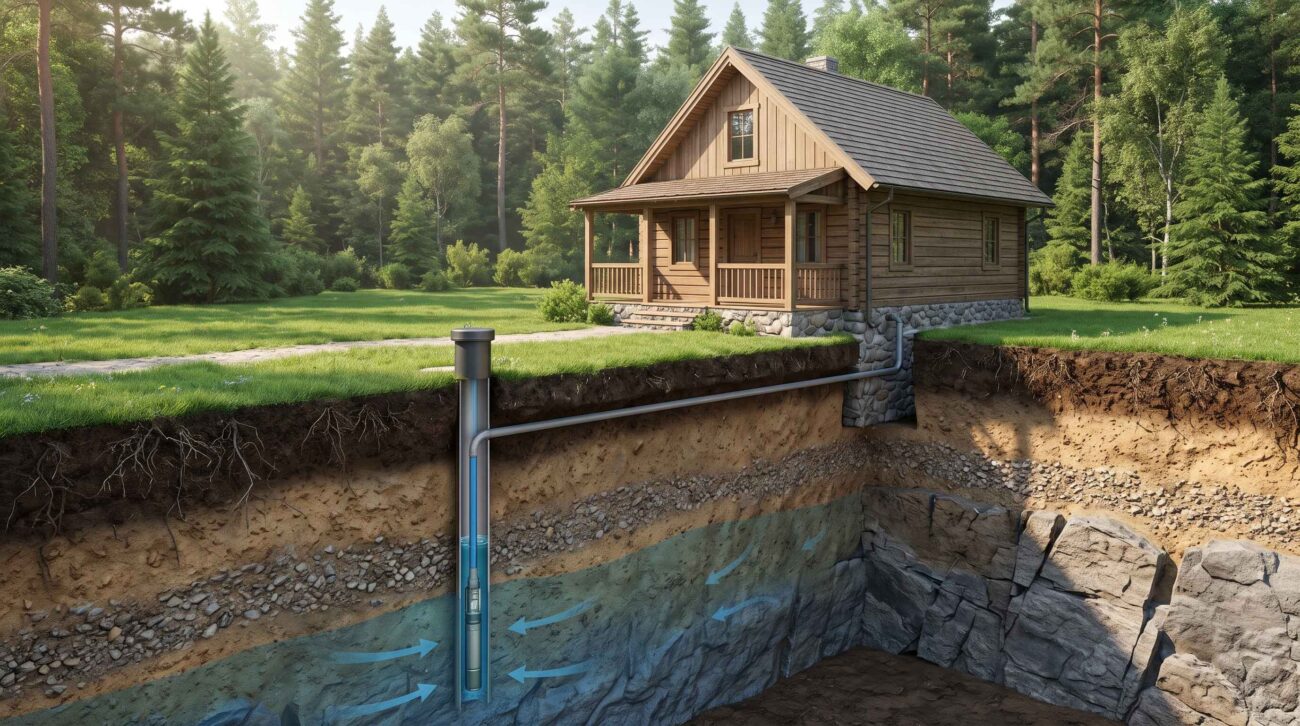
A secluded cabin with 30 wooded acres, mountain views, and a private water well can sound like an ideal rural retreat.
The property listing might describe the well as an attractive feature, especially where public water service is unavailable.
But the presence of a well does not automatically mean the property has a reliable supply of safe drinking water.
A well may produce water that contains contaminants, deliver insufficient water during periods of high demand, or require expensive equipment repairs.
Before buying rural property, it is important to understand what the well actually provides and what additional investigation may be necessary.
This guide explains how to evaluate private well water, review well records, arrange laboratory testing, investigate water availability, and identify potential warning signs before closing.
1. Understand What a Private Water Well Provides
A private well draws groundwater from beneath the land.
Depending on local geology and construction methods, wells may obtain water from different underground formations.
Common types include drilled wells, driven wells, and dug or bored wells.
These types can differ in depth, construction, vulnerability to contamination, and maintenance needs.
A typical modern drilled well may include a casing, sanitary well cap, pump, water line, pressure tank, and electrical controls.
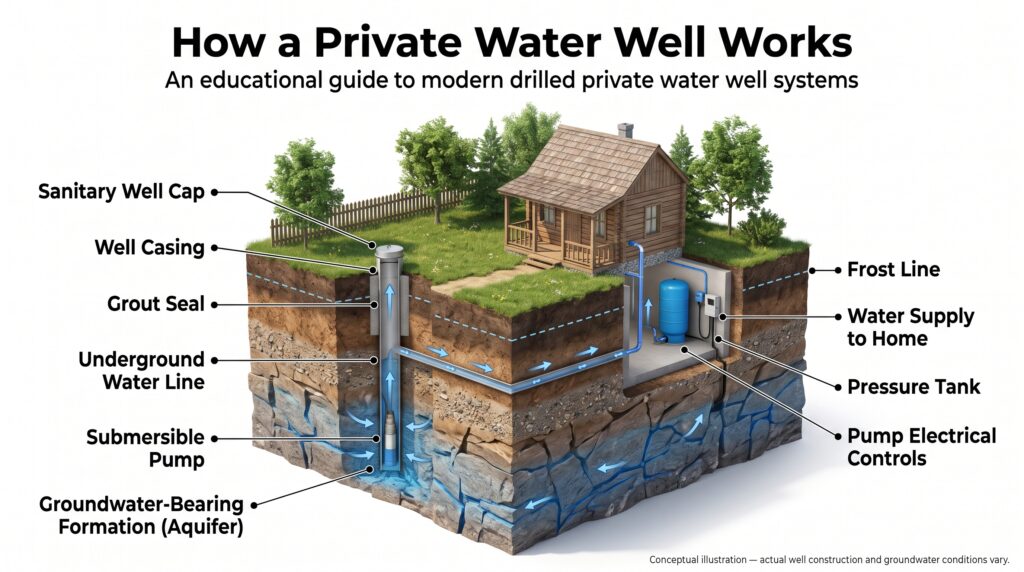
However, not every rural property has the same equipment or construction standards.
The Centers for Disease Control and Prevention explains that drilled wells are generally easier to protect from contamination than some shallow dug or bored wells.
Source: CDC — Well Water Safety.
Buyer takeaway: A listing that simply says “private well” does not provide enough information to evaluate the water system.
2. Understand Why Private Well Water Needs Testing
Private wells are generally not subject to the same federal drinking water regulations that apply to public water systems.
This means the property owner is typically responsible for monitoring water quality and arranging necessary testing.
Some state and local requirements may still apply, including rules for well construction, testing, or property transfers.
A well can produce water that looks clean but contains bacteria or chemical contaminants.
Taste, smell, and appearance alone cannot establish drinking water safety.
The CDC recommends testing private well water at least once each year for total coliform bacteria, nitrate, total dissolved solids, and pH.
Additional testing may be needed depending on local conditions.
Source: CDC — Guidelines for Testing Well Water.
3. Request the Well’s Construction and Maintenance Records
Before ordering tests, ask the seller for available documentation about the well.
Useful records may include:
- Original well drilling or construction report.
- Well depth and casing information.
- Pump installation and replacement records.
- Available yield or pumping test results.
- Water quality laboratory reports.
- Well inspection reports.
- Water treatment equipment records.
- Repair and maintenance history.
Some states maintain online well-log databases.
Depending on the location, the state environmental agency, geological survey, or water resources department may provide access to these records.
The records can help buyers identify what was installed, when it was installed, and what testing has previously been completed.
However, an old well log does not guarantee the well’s current performance.
Questions worth asking the seller
When was the well drilled?
Has the well ever run dry?
Has the pump been replaced?
Are there seasonal changes in water pressure or availability?
Has the well ever tested positive for contaminants?
Does the property use filtration, softening, or another treatment system?
Ask for documentation whenever possible.
4. Arrange an Independent Well Water Test
A recent laboratory report can provide important information about drinking water quality.
However, the testing should cover contaminants relevant to the property’s location and circumstances.
The CDC recommends using a state-certified laboratory.
A local health department can help identify appropriate tests and explain the results.
Common testing categories
| Test | What it helps evaluate |
|---|---|
| Total coliform bacteria | Possible pathways for microbial contamination |
| E. coli | Evidence of fecal contamination |
| Nitrate | Contamination concerns associated with fertilizers, waste, and other sources |
| pH | Acidity or alkalinity of the water |
| Total dissolved solids | Overall concentration of dissolved substances |
| Arsenic | A naturally occurring contaminant of concern in some regions |
| Lead | Potential contamination from plumbing or other sources |
| Other local contaminants | Region-specific risks such as pesticides, VOCs, or radionuclides |
Not every property needs every possible test.
The appropriate testing panel depends on local geology, land use, nearby contamination sources, and health department guidance.
Important: A basic bacteria test alone does not establish that well water is free from chemical contaminants.
Source: CDC — Guidelines for Testing Well Water.
5. Understand Water Quantity and Well Yield
Water quality and water availability are separate issues.
A well may produce safe water but not enough to support the intended household.
Well yield is often described in gallons per minute, or GPM.
However, a single GPM figure does not tell the whole story.
Water supply performance may also depend on storage capacity, groundwater recharge, pumping duration, seasonal conditions, and household demand.
For example, a small cabin used occasionally may have different water needs from a full-time home with several occupants, livestock, and irrigation.
A qualified well contractor or groundwater professional can evaluate the well’s performance and explain what testing is appropriate.
Questions to investigate
- What is the documented well yield?
- When was the yield measured?
- Was the test short or extended?
- Does the well have a history of seasonal shortages?
- Is water storage installed?
- Can the existing pump meet the intended demand?
- Are neighboring wells experiencing water availability problems?
Do not assume that a well with a high reported initial flow rate will provide the same output indefinitely.
6. Check the Well’s Physical Condition
A private well is more than a hole in the ground.
Its performance depends on the condition of the well structure and associated equipment.
A professional inspection may assess the visible wellhead, sanitary cap, casing, pump, pressure tank, electrical components, and plumbing connections.
The inspector may also recommend further investigation when records are missing or signs of trouble are present.
Warning signs to investigate
- Damaged or missing well cap.
- Visible cracks or corrosion around the casing.
- Repeated loss of water pressure.
- Pump cycling unusually often.
- Sediment appearing in household water.
- Unexplained changes in water color or odor.
- Evidence of flooding around the wellhead.
- Old equipment with limited maintenance records.
These observations do not prove that a well has failed, but they justify professional assessment.
A home inspection does not necessarily include a comprehensive well inspection or pumping test. Confirm the scope before hiring an inspector.
7. Investigate Nearby Contamination Sources
The surrounding land can affect groundwater quality.
Potential sources of contamination may include septic systems, livestock areas, agricultural operations, fuel storage, industrial activities, and waste disposal sites.
A nearby creek or wetland may also be relevant when evaluating flooding and shallow groundwater conditions.
The presence of one of these features does not automatically mean the well is contaminated.
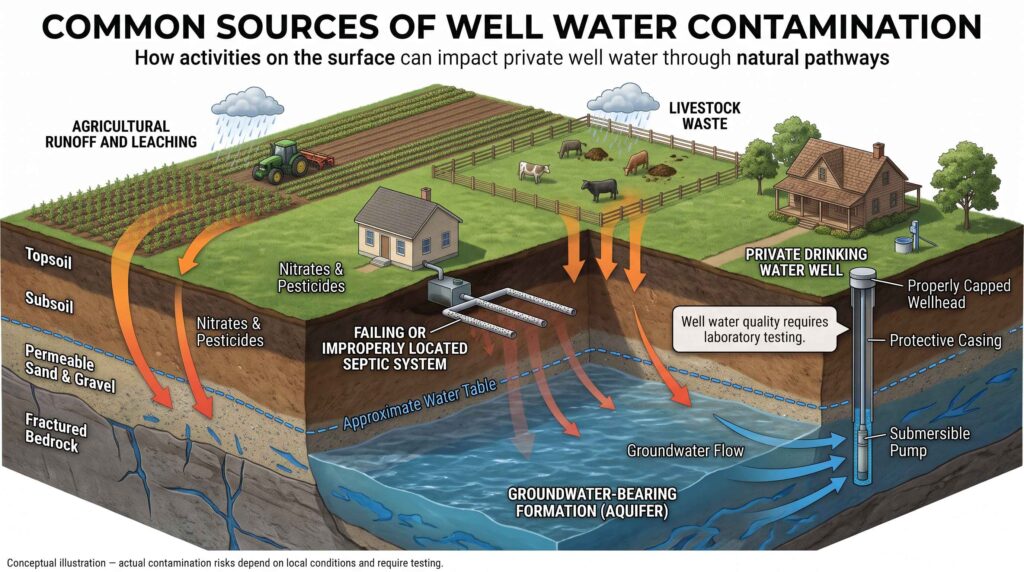
However, it may influence the tests and site investigations that professionals recommend.
Practical research steps
- Review the property’s layout and available survey.
- Identify the well’s approximate location.
- Locate septic tanks and drainfields, where known.
- Investigate nearby land uses.
- Ask the local health department about known groundwater concerns.
- Verify applicable well separation and construction requirements.
For related research, see How to Check Septic System Requirements Before Buying Rural Land.
8. Be Especially Careful With Flood-Prone Properties
Floodwater can carry contaminants into private wells.
Shallow wells and wells with damaged components may be particularly vulnerable.
If a well has been flooded or is suspected of contamination, do not assume that clear-looking water is safe.
The CDC advises contacting the appropriate health department and qualified professionals for guidance.
Water affected by fuel or certain chemicals cannot necessarily be made safe by boiling or ordinary disinfection.
Source: CDC — How to Disinfect Wells After an Emergency.
For a broader property assessment, read our Guide to Checking Flood Risk Before Buying Rural Land.
9. Understand Water Treatment Systems
Some properties use water treatment equipment to address specific water quality problems.
Examples include sediment filters, water softeners, ultraviolet disinfection, reverse osmosis, and other treatment technologies.
These systems serve different purposes.
A water softener is not automatically a solution for bacteria, and a basic sediment filter does not necessarily remove dissolved chemical contaminants.
The CDC emphasizes that no single treatment method protects against every possible water quality problem.
Source: CDC — Guidelines for Treating Well Water.
Before choosing equipment, obtain reliable laboratory results and consult an appropriate water treatment professional.
Ask what contaminants the equipment is designed to reduce, what certifications apply, and what maintenance is required.
A treatment system also does not resolve an insufficient water supply.
10. Evaluate Water Needs for an Off-Grid Cabin
Off-grid properties may use solar panels, generators, battery systems, or other independent power sources.
If a cabin relies on an electric well pump, the electrical system must be capable of operating that pump.
A property with a working well but no reliable power source may still require additional equipment.
Buyers should investigate pump startup requirements, water storage, pressure systems, backup power, and maintenance access.
Some rural cabins instead rely on springs, cisterns, hauled water, or rainwater collection.
These arrangements have different limitations and may be subject to local regulations.
Do not assume that an alternative water source is automatically safe for drinking.
For more on rural infrastructure, read Rural Property Utilities Checklist.
11. Budget for Well Repairs and Potential Replacement
A private well may involve several different expenses over time.
Possible costs include laboratory testing, professional inspections, pump repairs, pressure tank replacement, electrical work, treatment equipment, and ongoing maintenance.
If the existing well is unusable, drilling a replacement well may require permits, contractor availability, and additional investigation.
Drilling deeper does not guarantee adequate water or acceptable water quality.
The total cost varies considerably by location, geology, depth, access, equipment, and local requirements.
Rather than relying on a generic national estimate, request written quotes from licensed or appropriately qualified local contractors.
For additional budgeting considerations, read Hidden Costs of Buying Cheap Land in America.
12. A Practical Comparison of Two Rural Properties
Consider two fictional 25-acre properties.
Property A has an existing drilled well, recent laboratory results, documented pump maintenance, and a professional assessment of water supply performance.
Property B has an older well with no available construction log, uncertain pump condition, and no recent water quality report.
| Due diligence question | Property A | Property B |
|---|---|---|
| Acreage | 25 acres | 25 acres |
| Existing well | Yes | Yes |
| Construction records | Available | Not provided |
| Recent water testing | Available | Not available |
| Pump maintenance | Documented | Uncertain |
| Water supply assessment | Completed | Not completed |
| Main remaining concern | Review results and intended use | Requires additional testing and inspection |
Property A provides more information, but its records still need professional review.
Property B is not automatically unsuitable. It simply carries more uncertainty until its well is properly evaluated.
The lesson is straightforward: the existence of a private well does not tell a buyer whether the water system is safe, reliable, or suitable for future plans.
This comparison is fictional and does not describe actual properties.
13. Private Well Due Diligence Checklist
Before buying rural property with a private well, review the following items.
- Confirm whether the property uses a private well or public water.
- Identify the type and approximate age of the well.
- Request well construction records and drilling logs.
- Ask for pump installation and maintenance history.
- Obtain recent water quality reports.
- Arrange testing through a state-certified laboratory.
- Ask the health department which additional contaminants to test.
- Have the well and related equipment professionally inspected.
- Review available yield and pumping test information.
- Investigate seasonal water supply concerns.
- Locate nearby septic systems and potential contamination sources.
- Review flood exposure and wellhead protection.
- Assess the suitability of existing treatment equipment.
- Confirm that the system can meet the intended household demand.
- Obtain estimates for necessary repairs or improvements.
- Resolve major water quality and availability questions before closing.
Where appropriate, buyers can discuss well testing and inspection contingencies with their real estate agent or attorney.
Frequently Asked Questions
Is private well water safe to drink?
It can be, but safety should not be assumed. Appropriate laboratory testing is needed to evaluate contaminants that may affect drinking water.
How often should private well water be tested?
The CDC recommends annual testing for total coliform bacteria, nitrate, total dissolved solids, and pH, with additional testing when local conditions or changes warrant it.
Does a deep well always provide better water?
No. Depth alone does not guarantee water quality, sufficient yield, or protection from every contaminant.
Can I test well water myself?
Home screening kits may provide limited information, but important purchase decisions should rely on appropriate testing by a state-certified laboratory and professional interpretation when necessary.
Can boiling well water remove chemical contaminants?
No. Boiling can address certain microbial risks when recommended by health authorities, but it does not reliably remove chemical contamination and may concentrate some dissolved substances.
Does a home inspection include well testing?
Not necessarily. Confirm whether the inspection includes water sampling, equipment evaluation, and yield testing. Additional specialists may be needed.
Can a property with a low-yield well still be usable?
Possibly, depending on actual demand, storage, recharge, regulations, and professional assessment. A low-yield well should not automatically be assumed adequate for full-time residential use.
Final Thoughts
A private well can be a valuable feature of rural property, especially where municipal water service is unavailable.
However, buyers should evaluate the water system as carefully as the cabin, acreage, road access, and septic arrangements.
Start with the well records. Arrange appropriate water quality testing, investigate the condition of the equipment, and verify that the water supply can support the intended use.
If important questions remain, obtain professional advice before completing the purchase.
A rural property is not truly ready for a home simply because a well exists. Buyers need evidence that the water supply is safe, reliable, and appropriate for their plans.
Editorial Disclaimer: This article provides general educational information about private water wells and rural property research in the United States. Water quality, well construction requirements, groundwater availability, and property transfer regulations vary by location. EstatePath does not provide water testing, engineering, environmental consulting, or legal services. Consult your local health department, certified laboratories, qualified well contractors, and other appropriate professionals before making decisions about a specific property.
