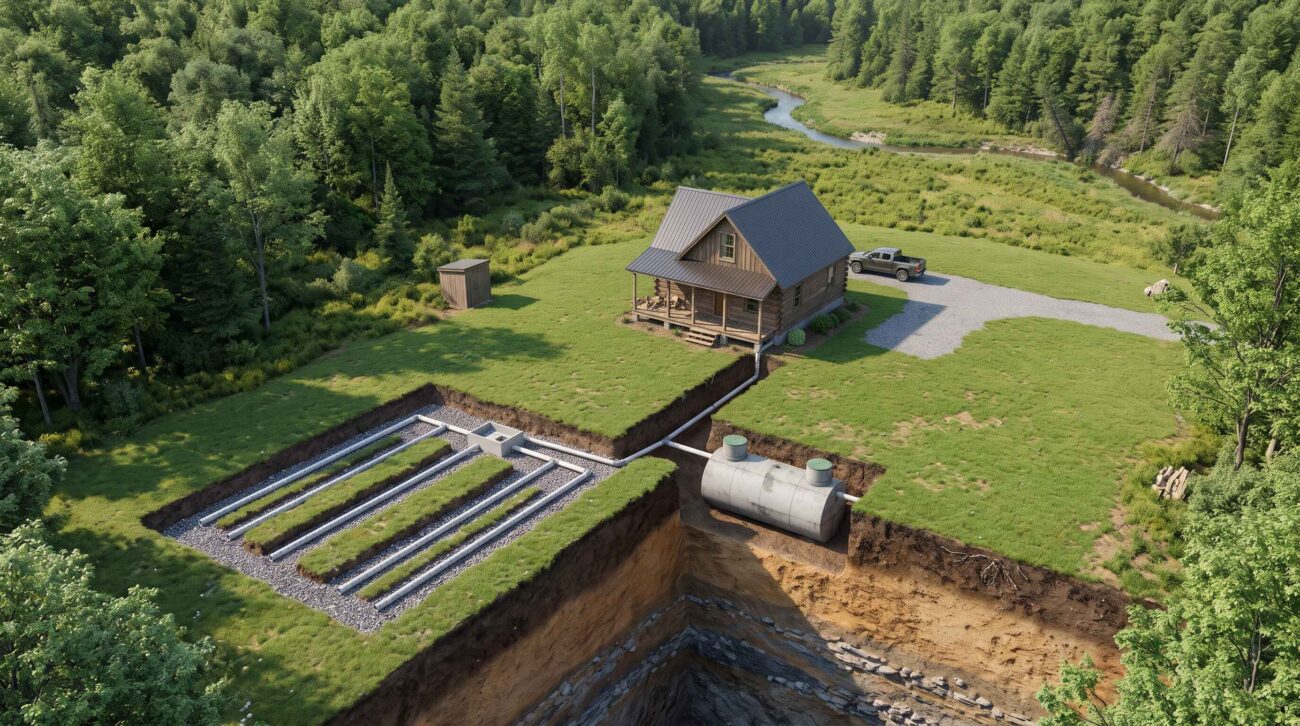
A wooded 20-acre property may have everything a rural buyer wants: privacy, mountain views, a creek, and enough space for a small cabin.
But there is one important detail that can determine whether a future home is practical: how will the property handle wastewater?
Many rural properties are not connected to a municipal sewer system. Instead, homeowners may need an approved onsite wastewater treatment system, commonly called a septic system.
A large parcel does not automatically qualify for a septic permit. Soil conditions, groundwater, slope, available space, local regulations, and the proposed home’s wastewater demand can all influence whether a system can be approved.
This guide explains how to research septic requirements before buying rural land in the United States, what to ask local officials, how to understand soil testing, and which warning signs deserve closer investigation.
1. Understand How a Septic System Works
A typical conventional septic system includes two main components: a septic tank and a drainfield.
Wastewater from sinks, toilets, showers, and other household plumbing flows into the septic tank.
Inside the tank, solids settle while fats and oils rise. Partially treated liquid then moves into the drainfield, where suitable soil provides further treatment and dispersal.
The soil is an essential part of the treatment process.
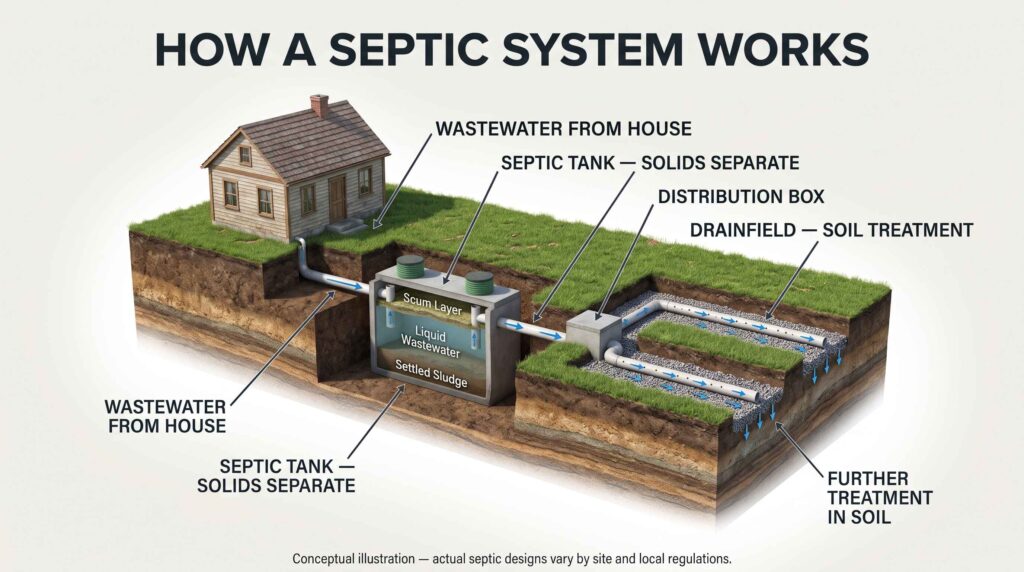
That is why septic suitability cannot be determined simply by looking at the size of a property.
The U.S. Environmental Protection Agency provides an accessible explanation of this process in its guide, How Septic Systems Work.
Buyer takeaway: A septic tank alone is not a complete wastewater disposal solution. The approved treatment and dispersal method matters just as much.
2. Find Out Who Regulates Septic Systems in the County
One of the first steps is identifying the authority responsible for onsite wastewater permits.
In many locations, this is a county health department, environmental health office, or state environmental agency.
Requirements differ significantly across states and counties.
According to the EPA, individual onsite wastewater systems are generally regulated by state, tribal, and local governments rather than through a single nationwide residential septic permit program.
Source: EPA — Frequent Questions on Septic Systems.
Questions to ask the permitting office
- Is an onsite septic system permitted on this parcel?
- What site evaluation is required before approval?
- Is a soil evaluation or percolation test necessary?
- Who is authorized to perform the evaluation?
- Are alternative systems permitted?
- What setbacks apply to wells, streams, buildings, and property lines?
- Is a designated replacement drainfield area required?
- Can the buyer apply for a site evaluation before purchasing the property?
- Does an earlier septic approval remain valid after a change in ownership or proposed house design?
Ask for written requirements or links to the applicable county and state regulations.
An informal statement that a property should be suitable is not the same as an issued permit.
3. Understand Soil Tests and Percolation Tests
A percolation test, often called a perc test, measures how quickly water moves through soil under specified test conditions.
However, a perc test is not the only way authorities evaluate septic suitability.
Some jurisdictions require a soil profile examination, test pits, seasonal water table assessment, or other site-specific evaluation by an approved professional.
The required procedure depends on local regulations.
What officials may evaluate
Soil texture and structure: Different soil types can absorb and treat wastewater differently.
Seasonal groundwater: A high water table can limit the depth of suitable unsaturated soil.
Bedrock depth: Shallow bedrock may restrict the space available for wastewater treatment.
Slope: Steep terrain can affect drainfield layout and installation.
Available area: The proposed system must fit within the usable portion of the parcel while meeting applicable setbacks.
A parcel may have attractive surface conditions but unsuitable soil beneath the ground.
Important: A passed perc test is not necessarily a final septic permit, and an old test result may not be sufficient for a new project.
4. Research Soil Conditions Using USDA Web Soil Survey
The USDA Natural Resources Conservation Service offers a free online resource called Web Soil Survey.
It provides mapped soil information that can help buyers identify potential limitations before paying for detailed field investigations.
Visit USDA Web Soil Survey.
How to begin
- Open Web Soil Survey.
- Locate the property using the address, map, or geographic area.
- Define an Area of Interest around the parcel.
- Review the mapped soil units.
- Look for relevant soil interpretations, including septic tank absorption field limitations where available.
- Save the report and discuss the findings with a qualified local professional.
Soil interpretations may flag concerns such as wetness, slow permeability, slope, or shallow bedrock.
However, USDA soil maps are screening tools. Their mapping scale and generalizations cannot replace a site-specific septic evaluation.
A property may contain different soil conditions within the same mapped unit.
For more information, see USDA NRCS — Soil Facts.
5. Check Whether the Land Has Enough Suitable Space
A 40-acre parcel may sound spacious, but acreage alone does not determine septic feasibility.
Imagine a fictional property with 40 acres of steep forest, a creek running through the valley, and a narrow level clearing near the road.
The only practical cabin site might be close to the driveway.
Meanwhile, the flattest area suitable for a drainfield could be affected by a waterway setback, a recorded easement, or poor soil conditions.
The buyer may need a different building location or an alternative wastewater design.
Areas that may need special consideration
- Steep slopes.
- Flood-prone lowlands.
- Wetlands and drainage channels.
- Shallow bedrock.
- Areas with high groundwater.
- Existing buildings and driveways.
- Wells and nearby surface water.
- Utility corridors and easements.
- Required replacement drainfield areas.
Exact setback distances vary by jurisdiction and system design. Do not rely on a single national distance chart.
Review our related guides on Property Boundaries and Flood Risk when evaluating the available building area.
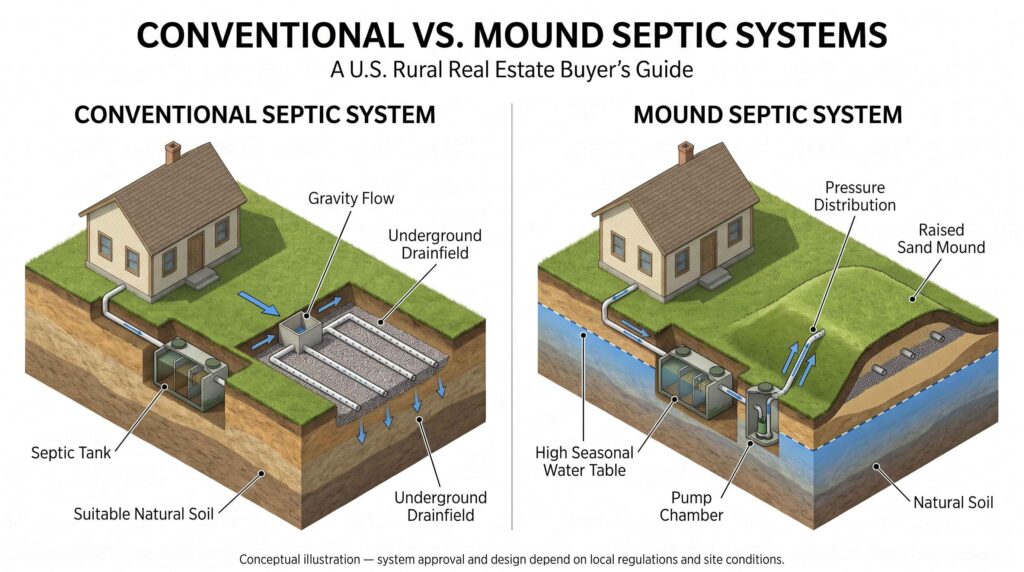
6. Know the Difference Between Conventional and Alternative Septic Systems
Not every property can use a standard gravity-fed septic system with a conventional drainfield.
Some locations may qualify for alternative systems designed to address specific site limitations.
The EPA describes several options, including mound systems, aerobic treatment units, drip distribution, and sand filters.
Source: EPA — Types of Septic Systems.
| System type | General characteristics | What buyers should investigate |
|---|---|---|
| Conventional septic system | Tank and soil absorption field | Soil suitability, drainfield space, setbacks |
| Mound system | Elevated engineered treatment area | Design requirements, land area, pumps, maintenance |
| Aerobic treatment unit | Uses oxygen-assisted treatment | Electrical needs, service agreements, inspections |
| Drip distribution | Disperses treated effluent through shallow tubing | Pumps, controls, maintenance, soil conditions |
| Sand filter system | Uses sand media for additional treatment | Installation complexity, pumping, maintenance |
These are general descriptions, not recommendations for a specific property.
An alternative system may be technically possible but financially or operationally unsuitable for a buyer.
Ask the permitting authority which technologies are approved locally and whether a qualified designer has evaluated the parcel.
7. Be Careful With Creekfront and Riverfront Land
Water features can make rural land attractive, especially for buyers interested in fishing, recreation, or a quiet cabin retreat.
But a creek or river may also create important wastewater design constraints.
Potential concerns include shallow groundwater, saturated soils, flood exposure, and required separation from surface water.
A septic system that is improperly located or maintained can threaten water quality.
Before purchasing creekfront property, determine where the home, well, septic tank, drainfield, and replacement area could legally be located.
The most scenic part of a parcel is not always the most suitable place for wastewater treatment.
Review the official flood information described in our Rural Land Flood Risk Guide.
8. Verify Existing Septic Systems on Properties With Cabins or Houses
An existing cabin does not prove that its wastewater system is approved, functioning, or adequate for future use.
A property listing may say:
- Septic installed.
- Private septic.
- Septic believed to be present.
- Septic condition unknown.
- Off-grid cabin with bathroom.
These descriptions should lead to additional questions.
Documents to request
Ask the seller for the original septic permit, approved design, installation records, inspection reports, pumping records, and repair history, if available.
The EPA recommends checking property records and contacting local permitting authorities to investigate existing systems.
Source: EPA — Septic System Frequently Asked Questions.
A qualified septic inspector may need to assess the tank, drainfield, visible components, and system performance.
The scope of an inspection varies. Ask what is included and whether additional testing is recommended.
If a cabin has been vacant for years, a brief inspection may not reveal how the system performs under regular household use.
9. Understand Why Bedroom Count Can Matter
Septic design requirements may depend on the anticipated wastewater flow from the proposed dwelling.
Local rules may use bedroom count, occupancy, fixture counts, or other design-flow criteria.
That means an approval associated with a small one-bedroom cabin may not automatically support a future four-bedroom house.
Before purchasing land with expansion plans, tell the permitting authority what you eventually intend to build.
Ask whether the proposed septic system can support that use or whether a new evaluation would be required.
Avoid assuming that an existing septic permit guarantees unlimited future development.
10. Budget for More Than the Septic Tank
Buyers sometimes focus on the price of a tank while overlooking the complete onsite wastewater project.
Potential expenses include site evaluation, soil testing, system design, permits, excavation, materials, installation, electrical connections, inspections, and future maintenance.
Remote properties can introduce additional logistical challenges.
For example, equipment may need to travel along a narrow gravel road, cross difficult terrain, or reach a distant building site.
Alternative systems may also involve pumps, electrical power, monitoring, and ongoing service.
There is no reliable single installation price for every rural property in the United States.
Obtain local, itemized quotes after the site has been evaluated and the required system type is understood.
For broader rural development planning, read Hidden Costs of Buying Cheap Land in America.
11. Check Septic Requirements for Off-Grid Cabins
Off-grid does not automatically mean exempt from wastewater regulations.
A cabin using solar panels, a generator, propane, or hauled water may still need an approved method of managing sewage and wastewater.
Composting toilets, holding tanks, and other alternatives may be regulated differently depending on the jurisdiction.
A composting toilet also does not necessarily resolve the disposal requirements for shower, sink, and laundry wastewater.
This wastewater is commonly called graywater, and its treatment and disposal may be regulated.
Before relying on any alternative arrangement, ask the local authority whether it is permitted for the intended residential or seasonal use.
Do not assume a system is legal because a neighboring cabin uses it.
12. A Practical Example: Two Hypothetical Rural Properties
Consider two fictional 20-acre parcels offered for sale.
Property A: A wooded parcel with moderate slopes, an accessible building area, and documented soil evaluation results. The county has issued a septic permit for a specified home design, subject to its conditions.
Property B: A creekside parcel with steep terrain and an attractive cabin site near the water. No recent soil evaluation or septic approval is available.
| Due diligence question | Property A | Property B |
|---|---|---|
| Advertised acreage | 20 acres | 20 acres |
| Soil evaluation | Documented | Not provided |
| Septic permit | Issued for specified design | Not confirmed |
| Terrain | Moderate slopes | Steep and creekside |
| Proposed building area | Identified | Needs evaluation |
| Remaining uncertainty | Permit conditions and site changes | Soil, setbacks, system feasibility |
Property A may offer more documented information, but its permit still needs to be reviewed for validity, transferability, and compatibility with the buyer’s plans.
Property B is not automatically unsuitable. It simply requires more investigation before a buyer can assess its wastewater options.
The lesson: Similar acreage and asking prices do not mean two parcels carry the same development risk.
These examples are fictional and do not represent actual properties or permitting decisions.
13. Septic System Due Diligence Checklist
Before making a final decision, use the following checklist.
- Confirm whether municipal sewer service is available.
- Identify the county or state septic permitting authority.
- Request written onsite wastewater requirements.
- Check for previous septic permits and soil evaluations.
- Ask whether existing approvals remain valid.
- Review USDA soil maps for preliminary limitations.
- Determine whether field soil testing is required.
- Verify proposed home size and wastewater design flow.
- Identify the building site and potential drainfield location.
- Check setbacks from wells, streams, roads, and property boundaries.
- Ask whether a replacement drainfield area is required.
- Investigate whether alternative systems are allowed.
- Obtain professional estimates for the approved design.
- Have any existing system professionally inspected.
- Confirm off-grid wastewater options with local officials.
- Resolve important septic feasibility questions before closing.
A suitable purchase contract contingency may help protect the buyer while required evaluations are completed. Discuss contract language with a qualified real estate professional or attorney.
Frequently Asked Questions
Can I install a septic system on any rural property?
No. Approval depends on local regulations and site-specific conditions, including soils, groundwater, slope, available space, and the proposed wastewater flow.
Does a property need a perc test before purchase?
Not necessarily. Requirements differ by location. Some jurisdictions use perc tests, while others rely on soil profile evaluations or other approved methods. Buyers should investigate septic feasibility before committing to land intended for residential development.
Can land fail a perc test and still support a septic system?
Possibly. Some jurisdictions allow alternative systems where conventional systems are unsuitable. However, alternative approval is not guaranteed.
Is a septic permit the same as a building permit?
No. They are separate approvals, although their requirements may interact. A septic permit alone does not establish that a home can legally be built.
Does an off-grid cabin need a septic system?
It may need an approved onsite wastewater solution. The requirements depend on the location, plumbing fixtures, occupancy, and applicable regulations.
Can a property have a septic system near a creek?
Possibly, but applicable waterway setbacks, groundwater conditions, soil suitability, and environmental protections must be evaluated.
Is an old septic permit still valid?
Not necessarily. Validity, expiration, transferability, and permitted use depend on the issuing authority and the terms of the approval.
Final Thoughts
Septic feasibility is one of the most important issues to investigate before buying rural land for a future cabin or home.
A beautiful property with generous acreage may still have limited space for an approved wastewater system.
Start by contacting the local permitting authority. Review existing records, investigate mapped soil limitations, and arrange the site-specific evaluations required for the intended project.
If a seller says a property is ready to build, ask for documentation rather than relying on the claim.
Before buying rural land, verify not only where a home could stand, but also how its wastewater can be legally and safely managed.
Editorial Disclaimer: This article is for general educational purposes only. Septic regulations, permit requirements, system designs, and soil evaluation methods vary by jurisdiction and individual property. EstatePath does not provide engineering, wastewater design, environmental consulting, or legal services. Consult the appropriate permitting authority and qualified local professionals before purchasing, designing, or installing a wastewater system.
