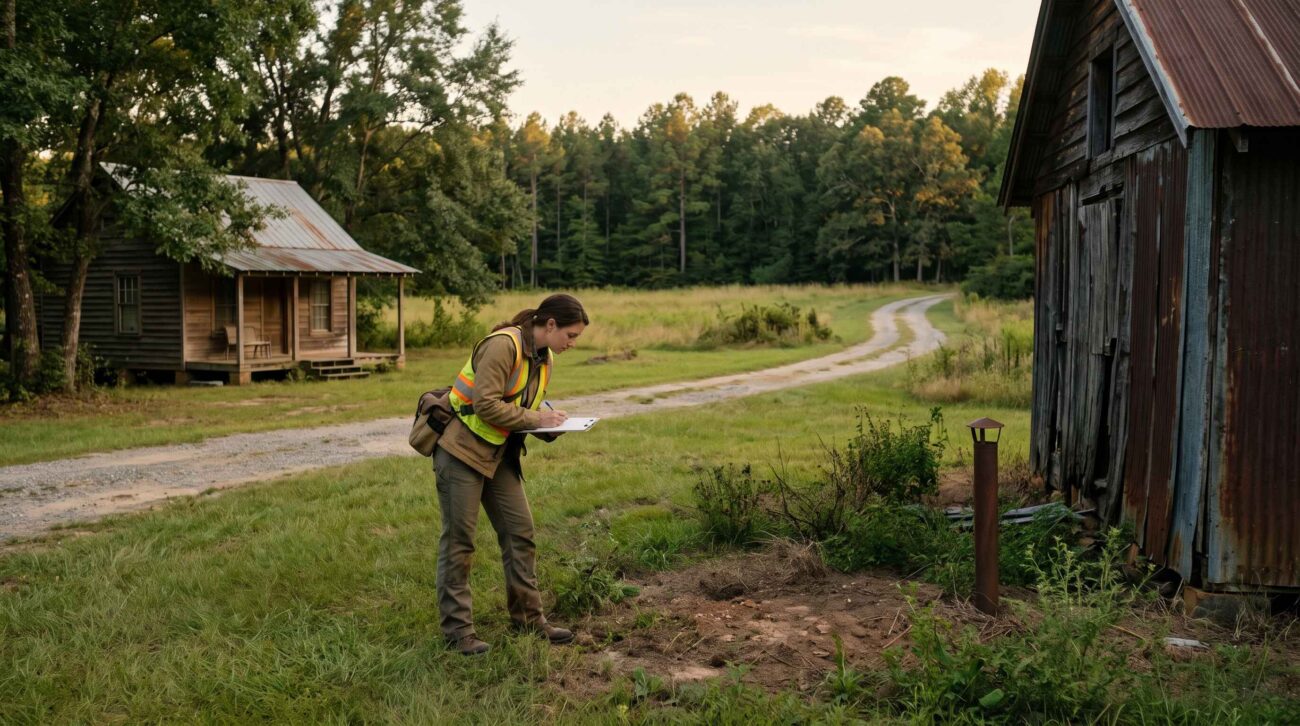
Buying rural land can offer privacy, natural scenery, and the opportunity to build a cabin, homestead, or weekend retreat. But a peaceful-looking property can also have an environmental history that is not obvious during a casual visit.
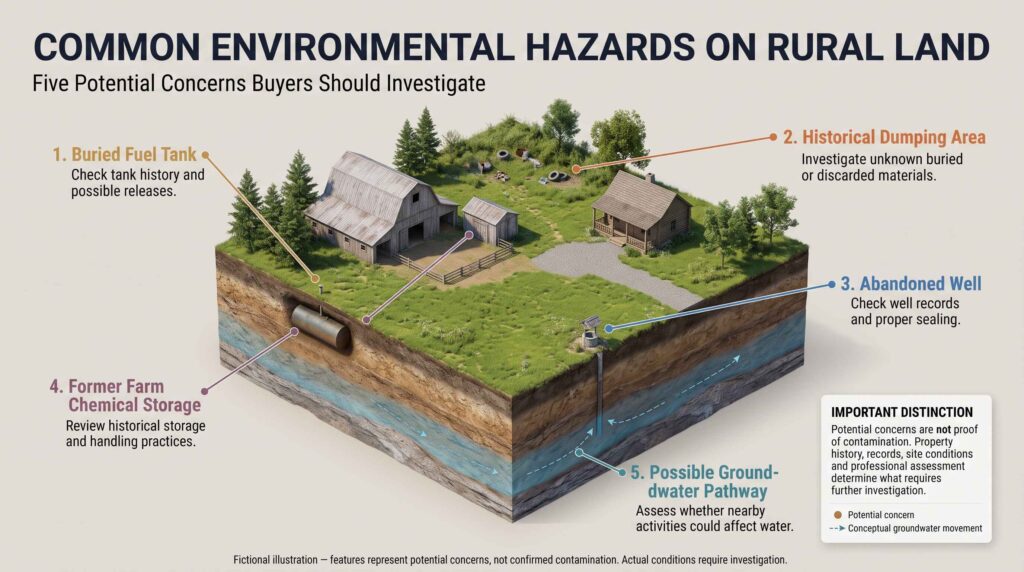
An old fuel tank may be buried near a former farm building. A wooded clearing might have been used for dumping. An abandoned structure could contain hazardous materials, while contamination from a neighboring property may affect soil or groundwater.
These possibilities do not mean that rural land is inherently unsafe. They mean buyers should investigate the property’s history, inspect its physical condition, and understand when professional environmental assessment is appropriate.
This guide explains how to identify potential environmental hazards before buying rural land in the United States, where to find government records, and what questions to ask before closing.
1. Why Environmental Due Diligence Matters
Environmental due diligence is the process of investigating a property’s current and historical conditions to identify possible contamination, hazardous materials, or other environmental concerns.
For rural land buyers, this may involve examining:
- Previous agricultural or industrial activities.
- Underground and aboveground storage tanks.
- Historical dumping or buried waste.
- Contaminated soil and groundwater.
- Abandoned wells and unidentified structures.
- Nearby contaminated properties.
- Existing environmental restrictions or cleanup obligations.
A property does not need to have been a factory to deserve environmental investigation.
For example, an older farm may have used fuel storage tanks, chemical storage buildings, or waste disposal areas. Whether those activities created contamination depends on the circumstances.
The U.S. Environmental Protection Agency (EPA) explains that evaluating past uses, government records, and site conditions is central to environmental due diligence.
Official source: EPA — All Appropriate Inquiries
2. Research the Property’s Historical Land Use
A property’s past can reveal risks that are difficult to recognize today.
A wooded parcel may once have contained agricultural buildings, a vehicle repair operation, or another activity involving potentially hazardous materials.
Historical records worth reviewing
Historical aerial photographs: Compare images from different decades to identify former buildings, disturbed ground, access roads, storage areas, and changes in vegetation.
Historical maps: Older topographic maps and available local maps may show structures, roads, ponds, pits, or previous land uses.
County property records: Tax assessments, permits, and recorded documents may provide clues about earlier development.
Previous owners and neighbors: People familiar with the property may know about old tanks, dumping, or demolished buildings.
Local government records: Planning, building, health, and environmental departments may hold information about past activities.
A historical feature is a reason to investigate, not proof that contamination exists.
For example, the outline of a demolished barn does not establish that hazardous materials were stored there.
Practical research approach
Begin with the property’s legal description and address. Compare historical photographs with current aerial imagery and county parcel maps.
Make a list of unexplained features and ask the seller about their history.
If records suggest a potentially contaminating use, consult a qualified environmental professional before proceeding.
3. Look for Underground Storage Tanks
Underground storage tanks, often called USTs, can be associated with fuel storage and other regulated substances.
Older rural properties may have had tanks serving farm operations, equipment, heating systems, or businesses.
Not every buried tank is leaking. However, a release from a tank can affect surrounding soil or groundwater.
Warning signs to investigate
- Unexplained metal pipes protruding from the ground.
- Old fuel dispensers or concrete equipment pads.
- Former fueling areas.
- Unidentified tank openings or vents.
- Historical records showing fuel storage.
- Seller disclosures mentioning removed or abandoned tanks.
These features are not conclusive evidence of a tank or contamination.
Use EPA UST Finder
EPA’s UST Finder provides a national mapping resource containing underground storage tank facilities and reported releases.
Official source: EPA — UST Finder
Search the property’s location and surrounding area, then review any potentially relevant records.
Important limitation: EPA’s national dataset includes historical reporting periods and may not contain every current or older tank. A property not appearing on the map should not be considered automatically free of underground storage tanks.
Contact the relevant state environmental agency for more complete or updated records.
Do not dig up, open, or disturb a suspected tank yourself. Seek professional assistance.
4. Investigate Illegal Dumping and Buried Waste
Remote land can sometimes contain discarded materials that were left by previous occupants or unauthorized visitors.
Possible examples include:
- Vehicle batteries.
- Old appliances.
- Chemical containers.
- Scrap metal.
- Construction debris.
- Tires.
- Discarded machinery.
- Unidentified drums.
Some discarded materials may be relatively straightforward to manage. Others may require special handling, testing, or regulated disposal.
What to look for during a property visit
Inspect accessible areas around old buildings, field edges, trails, former equipment yards, and disturbed ground.
Pay attention to unusual piles of material, stained soil, strong chemical odors, or containers with unknown contents.
Do not touch, open, move, smell directly, or attempt to identify unknown chemicals.
If suspicious waste is present, ask the seller for information and contact the appropriate environmental authority or qualified professional.
A cleanup estimate should be based on the actual materials, site conditions, and applicable disposal requirements.
5. Check for Soil Contamination
Soil contamination can result from various historical activities, including spills, improper waste disposal, or certain commercial and agricultural uses.
Possible contaminants depend on the property’s history.
Examples may include petroleum products, some pesticides, metals, and industrial chemicals.
Visible conditions that deserve attention
- Persistent unusual odors.
- Stained soil near former storage areas.
- Unexplained buried containers.
- Disturbed or filled areas of unknown origin.
- Historical evidence of spills.
- Areas associated with potentially contaminating activities.
These signs are clues, not a reliable contamination test.
Conversely, contaminated soil may appear completely normal.
Should buyers order soil testing?
Not every rural parcel requires the same tests.
Testing should be selected based on the property’s history, suspected contaminants, and intended use.
A qualified environmental professional can recommend appropriate sampling locations, laboratory methods, and interpretation.
Routine soil fertility testing for gardening does not establish whether a property is free of hazardous contamination.
For understanding agricultural soil properties, see our guide: How to Check Soil Quality Before Buying Land.
6. Investigate Groundwater and Private Wells
Groundwater conditions matter when a property relies on a private drinking-water well or when the buyer plans to install one.
Potential sources of groundwater contamination may include leaking storage tanks, improper chemical disposal, and certain nearby land uses.
However, the presence of a possible source does not automatically establish that a particular well is contaminated.
Questions to ask
- Does the property have an existing well?
- Are recent laboratory water-test results available?
- Have there been previous contamination concerns?
- Are there known nearby spills or cleanup sites?
- Does the property have abandoned or improperly sealed wells?
- Has a qualified professional recommended additional testing?
Water testing should be appropriate to local geology, nearby activities, and the well’s condition.
A basic water-quality test may not screen for every contaminant of concern.
For a more detailed buyer checklist, read How to Check Well Water Before Buying Rural Property.
7. Search EPA Environmental Databases
Government databases can help buyers identify documented environmental activities and cleanup sites.
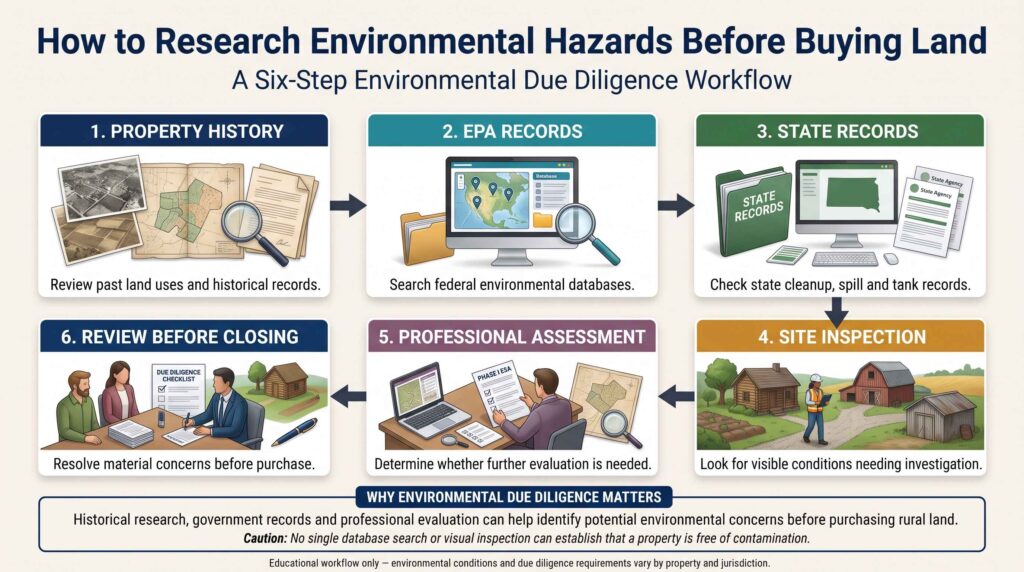
They are useful screening tools, but they are not substitutes for a complete property-specific investigation.
EPA Envirofacts and environmental maps
EPA’s environmental mapping resources allow users to explore facilities, cleanup activities, and other environmental data by location.
Official source: EPA — Maps and Visualizations
Start with the property’s address or nearby community.
Review the available layers and investigate potentially relevant facilities.
EPA Cleanups in My Community
This resource can help identify sites addressed under federal cleanup programs, including certain Superfund and Brownfields activities.
A nearby cleanup site is not, by itself, evidence that the property being purchased is contaminated.
Buyers should examine the nature of the contamination, site boundaries, groundwater information, and available investigation reports.
EPA UST Finder
Use this resource when investigating underground storage tanks and reported releases.
State environmental databases
State agencies may maintain additional records involving:
- Leaking underground storage tanks.
- Spill reports.
- Brownfield sites.
- Hazardous waste facilities.
- Environmental cleanup cases.
- Environmental permits and restrictions.
State records may be more current or detailed for particular programs.
Important: An empty search result does not prove that a property has never experienced contamination. Database coverage, reporting requirements, location accuracy, and update schedules vary.
8. Examine Neighboring Properties
Environmental due diligence should not stop at the parcel boundary.
Nearby activities may be relevant to the property under consideration.
Examples worth researching include former fuel stations, vehicle maintenance facilities, industrial sites, landfills, and documented cleanup properties.
The significance of a nearby site depends on factors such as the substances involved, whether a release occurred, environmental conditions, and the direction of potential contaminant movement.
Distance alone cannot establish safety or danger.
For example, groundwater does not necessarily flow in the same direction as the visible slope of the land.
If nearby records identify contamination, ask an environmental professional whether further investigation of the subject property is appropriate.
9. Inspect Abandoned Wells and Old Structures
Rural properties sometimes contain structures or openings that are poorly documented.
Examples include:
- Old water wells.
- Former farm buildings.
- Underground pits.
- Unidentified pipes.
- Old storage sheds.
- Abandoned equipment areas.
An abandoned well can present physical safety concerns and, if improperly constructed or sealed, may create a pathway for contaminants.
Old buildings may also contain materials requiring professional evaluation before renovation or demolition.
What buyers should do
Ask the seller for available well records, building permits, and information about abandoned structures.
Have qualified professionals inspect features that could present safety or environmental concerns.
Never enter an abandoned well, confined space, or unstable structure.
Do not assume that a structure’s age proves the presence of a particular hazardous material.
10. Understand Phase I Environmental Site Assessments
A Phase I Environmental Site Assessment, or Phase I ESA, is a professional process used to evaluate potential environmental concerns associated with a property.
A typical assessment includes review of historical information, regulatory records, site conditions, and relevant interviews.
It generally does not involve collecting soil or groundwater samples as part of the standard Phase I scope.
EPA recognizes ASTM E1527-21 and ASTM E2247-23 as standards consistent with its All Appropriate Inquiries rule. ASTM E2247-23 specifically addresses forestland or rural property.
Official source: EPA — All Appropriate Inquiries
When might a Phase I ESA be appropriate?
Buyers should consider discussing a Phase I ESA with an environmental professional when:
- The property’s history is unclear.
- Previous commercial or industrial uses are suspected.
- Underground tanks or dumping may have occurred.
- Nearby environmental records raise concerns.
- A lender requires environmental due diligence.
- The buyer is evaluating potential environmental liability.
A Phase I ESA may also be important when a purchaser seeks certain protections from liability under federal environmental law.
Those protections have specific eligibility requirements and continuing obligations. Ordering an assessment does not automatically eliminate liability.
What about Phase II testing?
When the initial investigation identifies conditions requiring further evaluation, a professional may recommend a Phase II assessment involving targeted sampling and laboratory analysis.
The appropriate scope depends on the concerns identified.
Official source: EPA — Eligible Planning Activities
11. Understand Environmental Liability Before Closing
Environmental problems can affect more than a property’s appearance or usability.
Depending on the circumstances, they may involve investigation costs, cleanup requirements, restrictions on land use, financing complications, or legal obligations.
Federal and state environmental laws differ in their application.
Under certain federal laws, ownership of contaminated property can create potential liability even when the current owner did not cause the original contamination.
EPA explains that specific liability protections may be available to qualifying purchasers, but those protections require compliance with legal conditions.
Official source: EPA — Brownfields All Appropriate Inquiries
Before purchasing property with a known or suspected environmental issue, consider obtaining advice from an environmental professional and an attorney experienced in applicable environmental law.
Do not rely solely on verbal assurances that a past problem has been resolved.
Request available investigation reports, cleanup records, closure letters, and relevant restrictions.
12. Review Environmental Restrictions and Recorded Documents
Some properties may have recorded restrictions related to contamination, cleanup activities, or ongoing environmental controls.
Depending on the circumstances, these may affect excavation, groundwater use, construction, or other activities.
Review title documents and ask the appropriate agencies whether environmental restrictions apply.
A recorded restriction is not necessarily evidence that a property cannot be used. Its meaning depends on the actual document and applicable requirements.
Our related guide, How to Check Deed Restrictions Before Buying Land, explains how to investigate recorded restrictions more generally.
13. Compare Two Fictional Rural Properties
Consider two hypothetical 40-acre properties offered at the same asking price.
These examples are fictional and do not represent actual listings or verified environmental conditions.
| Feature | Property A | Property B |
|---|---|---|
| Setting | Wooded countryside | Former agricultural property |
| Historical records | Primarily woodland | Older equipment and fuel-storage area |
| Visible concerns | None identified during initial visit | Unidentified pipe near former outbuilding |
| Government records | No relevant listing identified in initial screening | Nearby historical tank record requires investigation |
| Next step | Complete appropriate due diligence | Obtain additional records and professional advice |
| Conclusion | Environmental condition not yet established | Environmental condition not yet established |
Property B has more questions requiring investigation, but that does not prove it is contaminated.
Property A also cannot be declared contamination-free merely because initial screening found no obvious warning signs.
The purpose of due diligence is to replace assumptions with better evidence.
14. Environmental Hazards Buyers Should Never Ignore
The following situations deserve particular attention before closing:
Unknown buried tanks: Request available records and professional evaluation.
Unidentified drums or chemicals: Do not disturb them. Seek appropriate assistance.
Historical industrial activity: Investigate records and consider a professional assessment.
Known contamination or cleanup: Obtain the underlying reports and determine the current status.
Unexplained soil staining: Investigate the source rather than assuming it is harmless.
Nearby groundwater contamination: Ask whether the subject property’s water source may be affected.
Environmental restrictions: Review the actual recorded documents and agency requirements.
Seller uncertainty: Treat missing information as an unresolved question, not proof of a problem or proof of safety.
15. Environmental Due Diligence Checklist for Rural Land Buyers
Use this checklist before purchasing rural land:
- Confirm the property’s address and legal description.
- Review available historical aerial photographs.
- Investigate former buildings and land uses.
- Ask about underground and aboveground storage tanks.
- Search EPA UST Finder.
- Review relevant EPA environmental maps.
- Search state environmental agency records.
- Investigate nearby documented cleanup sites.
- Inspect accessible areas for discarded materials.
- Ask about abandoned wells and unidentified structures.
- Review available private well test results.
- Ask the seller for environmental reports and disclosures.
- Review title documents for relevant restrictions.
- Consult an environmental professional about unresolved concerns.
- Consider a Phase I ESA when appropriate.
- Obtain legal advice when potential liability is involved.
- Resolve material environmental questions before closing.
This checklist is a starting point, not a substitute for professional due diligence.
Frequently Asked Questions
Can rural land be contaminated even if it looks clean?
Yes. Some environmental conditions may not produce obvious visual signs. Historical research, government records, and appropriate professional testing may be necessary.
Does every rural property need a Phase I Environmental Site Assessment?
Not necessarily. The appropriate investigation depends on the property, transaction, financing requirements, intended use, and potential legal liability. Buyers seeking particular federal liability protections may need to meet formal All Appropriate Inquiries requirements.
Can an old underground fuel tank affect a rural property?
Potentially. A tank that has leaked may affect soil or groundwater. However, the existence of a tank does not automatically mean contamination occurred.
Is an EPA database search enough to confirm that land is safe?
No. Databases may be incomplete, outdated, or limited to certain reporting programs. A search should be one component of broader due diligence.
Can contamination from neighboring land affect my property?
It is possible, depending on the contaminant, environmental conditions, and pathways of movement. A qualified professional can assess whether a nearby issue is relevant.
Should I test soil before buying rural land?
Testing may be appropriate when the property’s history or physical conditions indicate a potential concern. A professional can help select relevant contaminants and sampling methods.
What should I do if I find suspicious containers or buried waste?
Avoid disturbing the materials. Contact the seller and seek advice from the appropriate environmental authority or qualified professional.
Can I still buy property with an environmental issue?
Possibly, but the decision requires careful evaluation of the actual condition, costs, restrictions, liability, financing, and intended use. Some transactions may require specialized environmental and legal advice.
Final Thoughts
Environmental due diligence is an important part of buying rural land responsibly.
A wooded parcel, old farmhouse, or remote cabin property may appear simple, but its historical uses and surrounding conditions can raise questions that deserve investigation.
Begin with historical research, government environmental databases, seller disclosures, and a careful site visit. When evidence suggests a possible problem, obtain qualified professional guidance before making a purchase decision.
The goal is not to assume every rural property is contaminated. It is to understand what is known, identify what remains uncertain, and make an informed decision.
Editorial Disclaimer
This article is provided for general educational purposes only and does not constitute environmental, engineering, legal, financial, or real estate advice.
Environmental conditions, database coverage, land-use requirements, liability rules, and professional assessment standards vary by property and jurisdiction. No screening method described here guarantees that land is free from contamination.
Before purchasing rural property, consult appropriately qualified environmental professionals, relevant government agencies, and legal advisers when necessary.
