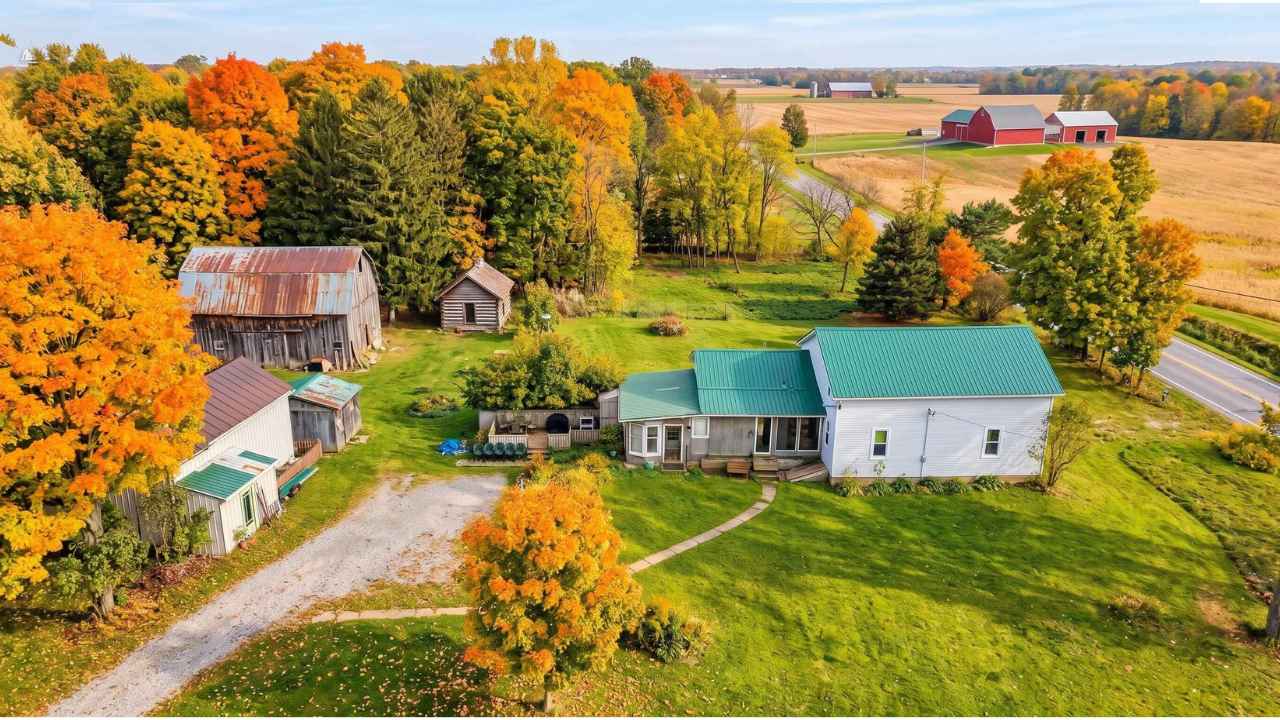
A rural farmhouse with a separate log cabin, historic barn, and space for a small hobby farm sounds appealing—especially at an asking price below $150,000. But the buildings are only part of the story.
At 1046 Peru Center Rd S in Monroeville, Ohio, a 1,900-square-foot farmhouse sits on 2.34 acres alongside a century-era barn, a small heated log cabin, a pole barn, and several animal enclosures.
The asking price was reduced from $160,000 to $148,900 in October 2026. That is an $11,100 reduction, or approximately 6.9% of the original asking price.
However, the listing also discloses important limitations involving the heating system, water supply, and financing. For a buyer interested in country living, those details deserve as much attention as the property’s attractive buildings.
This EstatePath analysis examines the features, practical possibilities, and questions that should be answered before making an offer.
Listing information was reviewed in November 2026. Price, availability, condition, and other details may change.
Ohio Farmhouse: Property Overview
| Property Detail | Listing Information |
|---|---|
| Address | 1046 Peru Center Rd S, Monroeville, OH 44847 |
| Asking price | $148,900 |
| Main residence | Approximately 1,900 sq ft |
| Bedrooms | 3 listed |
| Bathrooms | 2 full |
| Land | 2.34 acres |
| Home type | Two-story single-family farmhouse |
| Additional cabin | 18 × 14 ft, reportedly built in 2010 |
| Pole barn | 24 × 30 ft, reportedly built in 1992 |
| Other structures | Historic barn, workshop, animal enclosures |
| Water | Cistern currently in use; existing well mentioned |
| Wastewater | Septic tank and leach system listed |
| Electricity | Connected |
| Financing | Cash or rehabilitation loan only, per listing |
| MLS | Firelands MLS #20264073 |
The listed price works out to approximately $78.37 per square foot of farmhouse living area. However, that figure includes the land and other structures; it is not a reliable measure of the farmhouse’s condition or market value.
The parcel also represents approximately $63,632 per acre, including all improvements. Neither calculation should be treated as a land-only valuation.
Watch the Farmhouse Property Tour
Our EstatePath video introduces the farmhouse, its separate cabin, and the surrounding outbuildings.
The video provides an overview of the property. The analysis below focuses on questions that photographs and listing descriptions cannot answer.
1. The Farmhouse Has Character, but Its Condition Needs Investigation
According to the listing, the main house includes original wood floors, older cabinetry, traditional doors and hardware, a walk-in pantry, and a first-floor primary bedroom.
These features may appeal to buyers who prefer older homes over modern construction.
The listing photographs show a mixture of finished rooms and areas that appear to need cosmetic attention. Some walls have visibly worn finishes, and certain rooms show older materials.
That does not establish the presence of structural damage, mold, or unsafe conditions. Photographs alone cannot reliably determine those issues.
Before purchasing, a buyer should commission a qualified home inspection covering:
- Foundation, basement moisture, and visible structural movement.
- Roof condition, flashing, gutters, and drainage.
- Electrical panel, wiring, grounding, and safety devices.
- Plumbing, water pressure, and drainage.
- Insulation, ventilation, and heating performance.
- Windows, doors, floors, and signs of water intrusion.
- Possible lead-based paint and other age-related concerns.
The property’s construction year is not clearly provided in the listing. Buyers should verify it through county records and request relevant renovation permits.
For an older farmhouse, the important question is not simply how much original character remains. It is how much work is required to make the building safe, comfortable, and insurable.
2. The Heating System Is the Biggest Immediate Warning
The listing describes propane and wood-burning heat on the main floor, with a gas wall heater upstairs.
It also states that a wood-burning stove is included but disconnected for insurance-related reasons.
Most importantly, the seller specifies that the property is being offered for cash or a rehabilitation loan only because of the current heating arrangement.
That is a significant disclosure.
It suggests buyers should not assume the house will qualify for ordinary mortgage financing in its present condition. Actual eligibility depends on the lender, loan program, appraisal, and property inspection.
A buyer should obtain answers to four questions:
- Which heating components currently operate, and which are disconnected?
- Is the existing system adequate to heat the entire residence safely?
- What repairs or replacements would a licensed HVAC contractor recommend?
- Will an insurance company provide acceptable coverage before and after the proposed work?
An independent heating assessment and written repair estimate should come before deciding whether the purchase fits the buyer’s budget.
A low asking price can become much less attractive when essential systems need substantial work immediately after closing.
For more on expenses beyond the purchase price, see our guide to the hidden costs of buying cheap rural property.
3. The Water Supply Requires Careful Verification
The farmhouse reportedly receives water from a cistern.
The listing also mentions an existing well that might provide another water source after a new pump is installed. Rural water service is described as a possibility through a petition process.
These are three different situations—not three confirmed working water supplies.
The current cistern
A cistern stores water, but its reliability depends on how it is filled, maintained, treated, and protected from contamination.
Buyers should ask:
- Where does the cistern water originate?
- Is it delivered, collected from rainfall, or supplied another way?
- What is the storage capacity?
- Are the tank and plumbing in serviceable condition?
- Are treatment and filtration systems installed?
- Has the water been tested by an appropriate laboratory?
The existing well
A well that needs a pump is not the same as a tested, operational drinking-water system.
A buyer should request available well records and have a qualified professional assess the well’s condition, yield, equipment requirements, and water quality.
The Ohio Environmental Protection Agency’s guidance on private-well testing explains that local health departments are an important starting point and that certified laboratories can test drinking-water samples.
Potential rural water service
A possible connection through a petition should not be treated as an approved or budgeted project.
The buyer would need written information from the relevant water provider about service availability, approval requirements, installation costs, and any assessments.
EstatePath assessment: The water situation is manageable only if a buyer establishes a dependable, safe, and affordable supply before relying on the property as a full-time residence.
4. The Septic System Is Listed, but Its Condition Is Unknown
The listing identifies a septic tank and leach system.
That is useful information, but it does not establish the system’s age, capacity, permit status, or operating condition.
A septic inspection should address:
- Tank condition and accessibility.
- Evidence of leakage or backups.
- Drainfield performance.
- System location relative to the house, well, and outbuildings.
- Available installation, maintenance, and pumping records.
- Suitability for the intended number of occupants.
A buyer should contact the relevant local health department about available records and applicable inspection requirements.
This is especially important if the buyer plans to add bathrooms, convert the small cabin to living space, or expand the residence. Such changes may require additional approvals or wastewater capacity.
For a broader explanation of rural water, wastewater, and electricity systems, read our Rural Property Utilities Checklist.
5. The Separate Log Cabin Is Interesting—but Not Automatically a Guest House
One of the property’s most distinctive features is an 18-by-14-foot log cabin, reportedly built in 2010.
That gives it a footprint of approximately 252 square feet.
The listing describes the cabin as heated and suggests several possible uses, including a studio, playhouse, or guest space.
However, buyers should not assume it is approved for residential occupancy or short-term rental use.
Before planning to use the cabin as sleeping accommodation, verify:
- Whether it was built with required permits.
- Whether its electrical and heating installations are approved.
- Whether it has an approved water supply and bathroom access.
- Whether zoning permits a second dwelling or accessory living unit.
- Whether the building meets applicable occupancy and safety requirements.
A heated recreational cabin and a legally habitable guest residence are not necessarily the same thing.
This distinction matters if a buyer is considering rental income, multigenerational living, or a future accessory dwelling unit.
6. The Historic Barn and Pole Barn Add Utility—and Maintenance Obligations
The listing describes a historic barn with original log beams, workshop space, and a metal roof.
It also identifies a 24-by-30-foot pole barn, reportedly built in 1992.
The pole barn has a footprint of approximately 720 square feet, excluding its lean-to additions.
Additional structures can be valuable for equipment storage, hobby farming, woodworking, and other practical uses.
But older barns can also require expensive maintenance.
What to inspect in the historic barn
A specialist should evaluate the foundation, posts, beams, connections, roof structure, moisture damage, and any evidence of insect activity.
The presence of historic timbers does not by itself establish that the structure is sound.
What to inspect in the pole barn
Check the roof and wall panels, posts, drainage, doors, electrical installations, and floor condition.
Buyers should also verify the permitted use of each structure and confirm that property insurance can cover the intended activities.
A barn that looks useful in photographs may still require repairs before it can safely store valuable equipment or accommodate animals.
7. Can 2.34 Acres Support a Hobby Farm?
The listing includes a chicken coop, goat pen, and rabbit hutches.
Those structures make the property interesting to someone who wants a small-scale hobby farm.
But 2.34 acres is not automatically suitable for every agricultural activity.
Usable space depends on building footprints, setbacks, drainage, soil conditions, fencing, neighboring properties, and local land-use rules.
For example, keeping a few chickens is a different undertaking from maintaining multiple grazing animals.
Before buying, investigate:
- Whether the intended livestock is permitted.
- Animal limits, fencing rules, and setback requirements.
- Manure storage and runoff controls.
- Water availability for animals.
- Pasture quality and seasonal maintenance.
- Whether commercial sales or farm-related businesses are allowed.
The listing places the property in Greenfield Township. Buyers should confirm applicable requirements directly with the relevant township and county offices.
Our guide on checking zoning before buying rural land explains how to research permitted uses before committing to a purchase.
8. The Price Reduction Is Real, but It Does Not Prove a Bargain
The advertised price history is:
| Date | Asking Price |
|---|---|
| October 8, 2026 | $160,000 |
| October 14, 2026 | $152,000 |
| October 26, 2026 | $148,900 |
The total reduction is $11,100.
That may attract attention, but a price cut alone does not establish fair market value.
The property includes multiple structures and a farmhouse with financing-related limitations. Those factors complicate comparisons with renovated homes that qualify for conventional mortgages.
A proper valuation should consider recent comparable sales, the condition of the main residence, utility systems, the functional value of the outbuildings, and the cost of necessary repairs.
A buyer should avoid assuming that the value of each additional building can simply be added to the farmhouse’s estimated value.
9. Build a Repair Budget Before Making an Offer
The listing provides enough information to identify several areas that may require professional evaluation, but not enough to produce a trustworthy renovation estimate.
A useful preliminary budget should separate the following categories:
| Potential Expense | What to Verify |
|---|---|
| Heating | Repair or replacement scope, permits, insurance requirements |
| Water | Cistern condition, water testing, well pump, possible connection costs |
| Septic | Inspection, maintenance history, potential repairs |
| Farmhouse | Structural, electrical, plumbing, roof, and interior work |
| Historic barn | Structural stabilization and weatherproofing |
| Log cabin | Permits, heating safety, approved use |
| Pole barn | Roof, posts, drainage, electrical condition |
| Ownership costs | Taxes, insurance, utilities, upkeep, and equipment |
Do not assign a renovation cost from listing photographs alone.
Instead, obtain contractor estimates and keep a contingency reserve for conditions that cannot be seen during the first inspection.
For buyers considering a rehabilitation loan, the lender may have additional requirements concerning approved contractors, project schedules, inspections, and the scope of eligible repairs.
10. Buyer Risk Assessment
| Issue | Preliminary Risk | Reason |
|---|---|---|
| Heating and financing | High | Seller specifically limits financing options |
| Water supply | High | Cistern in use; well not confirmed operational |
| Septic system | Needs verification | System listed, condition undocumented |
| Farmhouse condition | Needs inspection | Age and repair scope not fully established |
| Historic barn | Needs specialist review | Older structural components |
| Log cabin occupancy | Needs legal verification | Heated does not necessarily mean approved as a dwelling |
| Hobby-farm plans | Needs zoning review | Animal and land-use rules may apply |
These ratings represent EstatePath’s editorial assessment of the disclosed uncertainties—not professional inspection findings.
11. Questions to Ask Before Purchasing
Before submitting an offer, request written answers to the following:
- Why is the property restricted to cash or rehabilitation financing?
- Which heating systems are currently operational?
- Can the seller provide heating inspection and maintenance records?
- How is the cistern filled, and when was its water last tested?
- What is known about the existing well’s condition and production?
- Are septic installation and maintenance records available?
- Are the historic barn, pole barn, and log cabin permitted structures?
- Is the separate cabin approved for overnight or residential use?
- What are the applicable rules for livestock and other hobby-farm activities?
- Have there been past water intrusion, structural, or insurance problems?
- Are there any easements, encroachments, or boundary disputes?
- What personal property, equipment, and appliances are included in the sale?
The answers may materially change both the property’s practical usefulness and the buyer’s total cost.
12. Who Might Find This Farmhouse Suitable?
This property could interest a buyer who values traditional farmhouse architecture, workshop space, and small-scale rural activities.
It may be particularly relevant to someone who has experience with older properties and can coordinate inspections, repairs, and improvements.
It may be less suitable for a buyer seeking a turnkey home, predictable maintenance costs, or a straightforward conventional mortgage.
The separate cabin and animal facilities are appealing features, but their value depends on condition, legal use, and the buyer’s specific plans.
Frequently Asked Questions
Is the Ohio farmhouse still for sale?
The listing was advertised at $148,900 and showed an active sale status when reviewed in early November 2026. Availability can change, so check the original listing or contact the listing agent for confirmation.
Does the property have a working well?
The listing states that the home currently uses a cistern and that an existing well may become usable after a new pump is installed. The well’s actual condition and water quality have not been independently verified.
Can the separate log cabin be used as a guest house?
Not necessarily. Its legal occupancy status, permits, sanitation facilities, and applicable zoning requirements must be confirmed.
Why is the seller asking for cash or a rehabilitation loan?
The listing specifically connects this limitation to the home’s heating arrangement. A buyer should confirm the exact issues with the seller, lender, insurer, and qualified contractors.
Is the property suitable for homesteading?
The outbuildings and animal enclosures may support certain hobby-farm activities, but water availability, usable land, livestock regulations, and operating costs must be evaluated first.
Final Assessment: A Property With Potential and Significant Questions
At $148,900, this Ohio farmhouse offers a combination that is not found in every rural listing: a traditional home, separate small cabin, historic barn, pole barn, and existing animal enclosures on 2.34 acres.
The appeal is understandable.
But the disclosed heating and financing limitations, reliance on a cistern, unverified well condition, and multiple older structures create important due-diligence requirements.
The most useful way to approach this property is not to ask whether the buildings look charming. It is to determine what they can legally and safely be used for—and what it will cost to maintain them.
For the right buyer, those answers may support a workable renovation and hobby-farm plan. For another buyer, the same findings may reveal costs or limitations that make the property unsuitable.
The asking price is only the starting point.
Property Listing and Research Sources
- Original Zillow listing — 1046 Peru Center Rd S, Monroeville, Ohio
- Ohio EPA — Testing Water From Private Wells
- USDA — Web Soil Survey
- FEMA — Flood Map Service Center
Editorial disclosure: This article is an independent educational analysis of a publicly advertised real estate listing. EstatePath is not the listing broker and has not independently inspected the property. Listing facts and advertised features may be incomplete or change over time. Readers should verify details with the listing agent, appropriate public authorities, and qualified professionals. This article is not financial, legal, engineering, or investment advice.
